
Ra is one of ancient Egypt’s most important solar gods. His daily movement across sky and underworld joined sunlight, kingship, creation, danger, death, and renewal into a single cosmic rhythm—far richer than the simple label “sun god” suggests.
Explore this figure in the interactive Gods & Goddesses Atlas.
At a glance
- Culture: ancient Egyptian
- Principal center: Iunu, called Heliopolis by the Greeks.
- Roles: solar power, creation, royal legitimacy, cosmic order, and daily renewal.
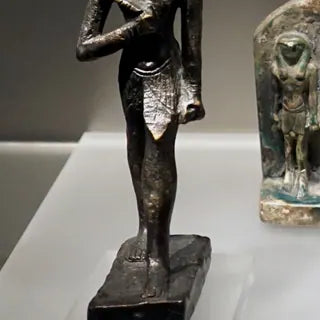
- Common forms: falcon-headed man with solar disk, solar disk itself, scarab at dawn, and ram-headed form at night.
- Important combined forms include Ra-Horakhty and Amun-Ra; these unions did not erase the histories of the gods involved.

Heliopolis and the rise of Ra
Ra’s major theological center was Iunu in Lower Egypt. Old Kingdom kings increasingly styled themselves “sons of Ra,” and solar temples made royal power part of the god’s ordered cycle. The Heliopolitan creation tradition places Atum at the beginning of the divine family; Ra and Atum could be joined as Ra-Atum without becoming a single unchanging figure in every text.
Egyptian theology worked through addition and association. Amun-Ra linked the hidden, imperial god Amun with solar supremacy; Ra-Horakhty joined Ra with Horus of the Horizons. Such forms are better understood as theological relationships than as evidence that all Egyptian gods were interchangeable.
The solar barque and the daily journey
Texts and temple images imagine Ra travelling across the daytime sky in a divine boat accompanied by other gods. At sunset he enters the western horizon and passes through the dangerous night world. There he confronts the serpent Apophis, whose attack threatens ordered existence.
Sunrise is therefore not automatic scenery. It is renewed victory: the aged evening sun is transformed and reborn. Funerary books placed the deceased within this cycle, offering hope that death could be passage, testing, and restoration rather than final extinction.
Creation, kingship, and ma’at
Several Egyptian creation traditions credit a solar creator with bringing gods and the ordered world into being through speech, bodily generation, tears, or emergence from the primeval waters. These accounts coexist with Memphite, Hermopolitan, and other systems.
Kingship was charged with sustaining ma’at, the just and balanced order established by the gods. By calling the king son of Ra, royal ideology presented government, temple ritual, and cosmic stability as connected responsibilities—not merely personal worship of the sun.
The Eye of Ra and divine goddesses
The Eye of Ra can act as the god’s protective, royal, and destructive power. In different stories this force is embodied by goddesses including Hathor, Sekhmet, Bastet, and others. One cycle tells of a raging Eye who must be pacified and returned.
The Eye of Ra should not be casually confused with the Eye of Horus. Their meanings overlap around protection and restoration, but their mythic relationships and uses are not identical.
Symbols and identification
The solar disk, falcon, cobra or uraeus, solar barque, horizon sign, scarab, ram, and Eye of Ra can identify parts of Ra’s theology. A falcon-headed god with a sun disk may be Ra-Horakhty or another solar form, so inscriptions and context are essential.
Modern Pagan reception
Modern practice can use sunrise observation, disciplined renewal, responsible leadership, and attention to the daily dependence of life on solar energy. These are contemporary applications, not a claim that ancient rites have survived unchanged.
Avoid treating every Egyptian solar symbol as the same or turning the struggle with Apophis into a simplistic moral dualism. Egyptian order and chaos are more complex than a Christianized battle between one good and one evil god.
Continue exploring
- Egyptian Pantheon: gods, goddesses, family tree, and symbols
- Thoth: writing, knowledge, time, and the Moon
- Osiris: regeneration and the afterlife
Frequently asked questions
Is Ra the same as Horus?
No. They have distinct histories, although solar theology could unite them as Ra-Horakhty, Ra-Horus of the Horizons.
What happens to Ra at night?
Funerary texts describe him travelling through the night world, overcoming danger, joining regenerative powers, and emerging renewed at dawn.
Is the Eye of Ra a goddess?
It is a divine power that can be personified through several goddesses. No single goddess exhausts every form of the Eye.
What is Ra’s main symbol?
The solar disk is central, often paired with a falcon head and protective cobra.
Sources and further reading
Last reviewed: August 1, 2026. Ancient evidence, later reception, and modern practice are labelled separately.