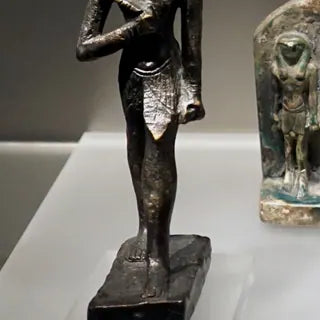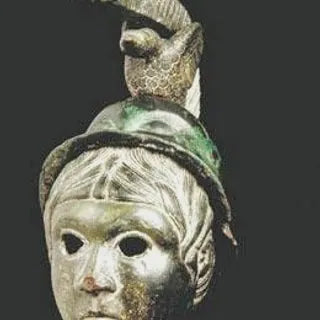



Thoth is the Egyptian god of writing, learned knowledge, calculation, ritual speech, time, mediation, and the Moon. His authority rests not in vague “wisdom” but in accurate words, measured cycles, preserved records, and the restoration of order.
Explore this figure in the interactive Gods & Goddesses Atlas.
At a glance
- Culture: ancient Egyptian
- Egyptian name: Djehuty; “Thoth” comes through Greek usage.
- Principal center: Khmun, known to the Greeks as Hermopolis.
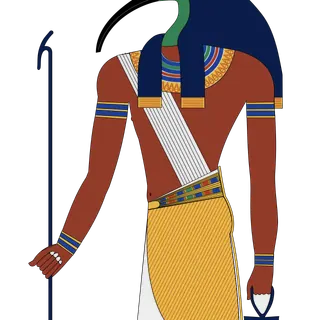
- Forms: ibis-headed man, full ibis, or baboon.
- Roles: writing, scribes, reckoning, lunar time, ritual language, mediation, and recording divine judgment.
Thoth in Egyptian religion
Thoth is attested across a long span of Egyptian history. At Khmun he belonged to a local creation theology associated with the Ogdoad, eight primordial powers. Elsewhere he serves the larger divine community as scribe, messenger, mediator, and master of effective ritual words.
Calling him the inventor of writing expresses the sacred importance of recorded language. Temple ritual, administration, medicine, astronomy, and funerary knowledge all depended on specialist literacy, so divine patronage of writing also supported the institutions that maintained Egyptian society.
Moon, time, and calculation
The lunar cycle made Thoth a god of reckoning, calendars, and measured time. Egyptian texts could speak of the Moon as restored after injury or diminution, linking calculation with healing and cosmic balance.
A later story tells how Thoth won additional days from the Moon so Nut could give birth to Osiris, Isis, Seth, Nephthys, and Horus the Elder. The tale is not a modern scientific explanation of the calendar; it dramatizes mastery of measure and the creation of ordered time.
Scribe and divine judge
In judgment scenes Thoth records the result when the heart is weighed against the feather of ma’at. Anubis attends the balance and Osiris presides. Thoth’s role emphasizes that judgment must be witnessed, measured, and accurately recorded.
He also mediates disputes, particularly those involving Horus and Seth. In some traditions he heals or restores the damaged Eye of Horus, making knowledge an active force that repairs broken order rather than a collection of abstract ideas.
Thoth, Hermes, and Hermeticism
Greek speakers in Egypt identified Thoth with Hermes because both were connected with language, mediation, and learned arts. From this encounter developed Hermes Trismegistus, the legendary authority of Greek and later Hermetic writings.
Hermetic texts are historically important, but they were written in the Greco-Roman world, not personally authored by a pharaonic god. Modern occult books attributed to “Thoth” should therefore be separated from ancient Egyptian evidence.
Symbols and identification
The ibis, baboon, scribal palette, reed pen, papyrus roll, lunar disk and crescent, and sometimes the was-scepter identify Thoth. Animal mummies show the scale of his cult, but modern visitors should remember that these were ritual objects within an ancient economy, not decorative curiosities.
Modern Pagan reception
Contemporary practice may center careful study, honest record-keeping, translation, mathematics, responsible speech, and respect for archives. A useful devotional principle is accuracy: verify a claim before repeating it and acknowledge uncertainty where sources disagree.
Avoid presenting modern tarot, channelled books, or “Atlantean” narratives as Egyptian history. They belong to later esoteric reception and require different labels and sources.
Continue exploring
- Egyptian Pantheon: gods, goddesses, family tree, and symbols
- Anubis: embalming, cemeteries, and the dead
- Ra: solar barque, kingship, and renewal
Frequently asked questions
What is Thoth the god of?
He is associated with writing, knowledge, calculation, ritual speech, mediation, lunar time, and the recording of judgment.
Why is Thoth shown with an ibis head?
The ibis was one of his sacred animal forms. He could also appear as a baboon or as a fully animal figure.
Is Thoth Hermes Trismegistus?
Thoth was identified with Hermes in Greco-Roman Egypt, helping create the later literary figure Hermes Trismegistus, but the two are not historically identical.
Did Thoth write the Emerald Tablet?
No ancient Egyptian evidence supports that claim. The Emerald Tablet belongs to a much later Arabic and Latin alchemical tradition.
Sources and further reading
Last reviewed: August 1, 2026. Ancient evidence, later reception, and modern practice are labelled separately.