
Anubis is an ancient Egyptian god of embalming, cemeteries, protection of the dead, and safe passage through funerary transformation. Calling him simply the “god of death” misses both his practical ritual role and the way his place in Egyptian religion changed over more than two millennia.
Explore this figure in the interactive Gods & Goddesses Atlas.
At a glance
- Culture: ancient Egyptian
- Egyptian names include Inpu or Anpu; “Anubis” is the Greek form.
- Principal roles: embalming, cemetery protection, funerary passage, judgment, and care of the corpse.
- Common forms: a recumbent black canid or a human body with a black canid head.
- Important titles include “He Who Is upon His Mountain” and “Foremost of the Westerners,” although titles and prominence varied by period.
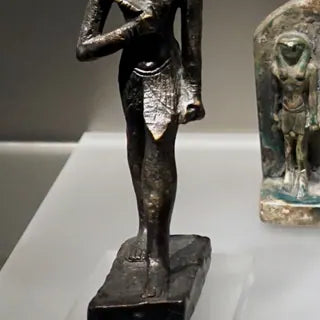
Name, history, and cult
Anubis is attested from the Early Dynastic Period and Old Kingdom, long before the fully developed Osiris cycle familiar from later retellings. Early royal and elite funerary texts give him authority over burial grounds and the treatment of the dead. His worship was especially associated with necropolises—the desert margins where cultivated land met the realm of burial—and with places the Greeks later called Cynopolis.
As Osiris became the dominant ruler of the underworld, Anubis did not disappear. His functions were reorganized within a wider Osirian system: Osiris ruled the renewed dead, while Anubis prepared, protected, guided, and presented the deceased for judgment. Egyptian religion frequently allowed divine roles to overlap rather than demanding one exclusive “god of” each subject.
Embalming and funerary ritual
Anubis was closely connected with the embalmer’s work. In ritual scenes a priest wearing a canid mask could represent him while attending the mummy. Texts call on Anubis to restore the body, protect the wrappings, open safe roads, and prevent hostile forces from damaging the deceased.
The famous black color is symbolic. It can recall the darkened appearance of a treated body, but also the fertile black soil deposited by the Nile. In that sense black joins death to regeneration: preservation of the body prepared the deceased for a transformed life rather than celebrating decay.
Judgment and the weighing of the heart
In New Kingdom Books of the Dead, Anubis commonly attends the balance on which the heart is weighed against the feather of ma’at—truth, justice, and proper order. Thoth records the result, Osiris presides, and the devourer Ammit waits if the heart fails. These images describe a network of divine roles, not a solitary Anubis deciding every fate.
Anubis also guides the deceased toward the tribunal. This psychopomp function helps explain why modern readers compare him with Greek Hermes, but comparison should not erase the distinct Egyptian ritual system in which he operated.
Myths and changing family relationships
Egyptian sources do not give Anubis one fixed genealogy. Some traditions call him a son of Ra; later Osirian narratives connect him with Osiris and Nephthys, and Plutarch preserves a much later Greek-language version in which Isis raises him. The variations reflect local theology and historical change, not an error that needs one final family tree.
In the Osiris complex, Anubis embalms the murdered god and becomes the divine model for funerary treatment. This relationship places craft, care, and protection at the center of his identity.
Symbols and identification
The black canid, recumbent shrine guardian, mummy bandages, embalming equipment, cemetery standards, and the judgment scales are the most reliable attributes. The animal is conventionally called a jackal, though Egypt’s wild canids are difficult to identify by modern species labels. Context matters: scales alone may belong to a judgment scene, while a black canid above a shrine more directly signals Anubis.
Modern Pagan reception
Contemporary devotion often emphasizes remembrance, cemetery care, grief, ethical preparation, and protection during transitions. These themes can be meaningful when clearly labelled modern rather than presented as reconstructed pharaonic ritual.
Human remains, tombs, and funerary objects deserve particular respect. Avoid removing objects from burial places, imitating restricted professional rites, or treating modern Egypt as merely a backdrop for an imagined ancient spirituality.
Continue exploring
- Egyptian Pantheon: gods, goddesses, family tree, and symbols
- Anubis vs Osiris: roles, symbols, and the Egyptian afterlife
- Osiris: god of the dead, regeneration, and kingship
Frequently asked questions
Is Anubis the Egyptian god of death?
He is strongly associated with the dead, but his more precise roles concern embalming, cemetery protection, guidance, and funerary transformation. Osiris became the principal ruler of the renewed dead.
Why is Anubis black?
The color evokes both the transformed embalmed body and the fertile Nile soil, linking funerary preservation with regeneration.
Did priests wear Anubis masks?
Ritual imagery and surviving masks support the performance of Anubis by funerary personnel, although the exact practice varied across periods and ceremonies.
Is Anubis evil?
No. He is a protective and necessary funerary deity, not an Egyptian equivalent of a devil.
Sources and further reading
Last reviewed: August 1, 2026. Ancient evidence, later reception, and modern practice are labelled separately.