

Athena is a Greek goddess of city protection, strategic warfare, skilled craft, weaving, counsel, and disciplined intelligence. The familiar “goddess of wisdom” is accurate but incomplete: ancient worship connected thought to civic responsibility, terrifying protection, physical skill, and the work of making.
Explore this figure in the interactive Gods & Goddesses Atlas.
At a glance
- Culture: ancient Greek
- Major center: Athens, though Athena had important cults throughout the Greek world.
- Parentage: usually born from the head of Zeus; some traditions include Metis in the story.
- Roles: civic guardianship, strategy, weaving, craft, counsel, heroic assistance, and ordered competition.
- Key forms and titles include Athena Polias, Parthenos, Promachos, Ergane, Nike, and Alea.
Birth and divine family
In Hesiodic tradition Zeus swallows Metis after learning that she may bear a dangerously powerful child. Athena later emerges from his head, fully armed. Other sources vary in detail, but the image makes her both daughter of Zeus and embodiment of counsel brought into royal authority.
Her birth is not a simple claim that intellect belongs only to Zeus. Metis means skill or cunning intelligence, and the swallowed mother remains an important part of the myth’s tension around power, succession, and the control of female generative force.
Athena and the city of Athens
As Athena Polias, “Athena of the City,” she stood at the center of Athenian civic identity. The Panathenaia brought procession, sacrifice, athletic and musical contests, and the presentation of a woven peplos for the goddess. Religious devotion, public display, citizenship, labor, and political hierarchy met in the festival.
The contest between Athena and Poseidon explained her patronage of Athens. Athena offered the olive, while Poseidon produced a salt spring or horse in different tellings. The story values the city’s chosen relationship with the goddess, but it also reflects later Athenian storytelling rather than a neutral record of an original event.
Warfare, craft, and weaving
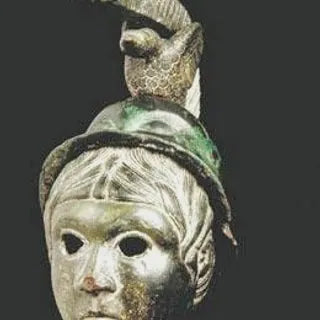
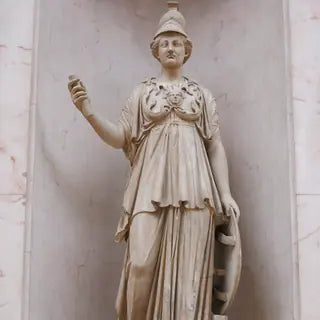
Athena’s warfare is organized, protective, and tactical, though the contrast with Ares should not be exaggerated into “good war” versus “bad war.” She carries spear, helmet, shield, and aegis, and she can be frightening in battle.
As Athena Ergane she protects workers and skilled production. Weaving was economically and socially central, not a decorative hobby. Myths involving Arachne, whose fullest surviving form is Roman, explore mastery, rivalry, punishment, and the risks of challenging divine status.
Heroes and mythic relationships
Athena supports heroes including Odysseus, Perseus, Heracles, and Jason. Her assistance usually rewards planning, restraint, technical skill, or a relationship with the civic order she represents. She does not help every hero unconditionally.
The aegis and Gorgoneion link her protective power to the terrifying head of Medusa. Versions of Medusa’s story differ sharply across Greek and Roman sources, so modern summaries should not combine them without attribution.
Local cults and Roman Minerva
Athena Alea at Tegea, Athena Lindia on Rhodes, and other local forms show that there was no single uniform cult. Titles tell us what a community asked from the goddess and how it located her power.
Romans strongly identified Athena with Minerva, especially in art and literature. Minerva nevertheless belonged to Roman institutions and the Capitoline Triad, so the two names should not be used as if cultural history were irrelevant.
Symbols and identification
The owl, olive, spear, helmet, shield, aegis, snake, Gorgoneion, and woven peplos are well-attested attributes. The owl appears prominently on Athenian coinage, but not every owl image is a devotional sign. The aegis and Gorgon head express protective terror as much as calm wisdom.
Modern Pagan reception
Modern practitioners may approach Athena through study, strategy, craft, public service, mediation, and disciplined protection. A historically aware practice asks how knowledge is used and whom a city or institution protects.
Avoid reducing Athena to a modern productivity icon or “girlboss.” Her ancient profile includes hierarchy, violence, civic exclusion, and myths that require critical reading rather than effortless celebration.
Continue exploring
- Greek Pantheon: gods, goddesses, family tree, and symbols
- Athena’s symbols: owl, aegis, Gorgoneion, olive, spear, and helmet
- Artemis: hunt, wilderness, girls, and childbirth
Frequently asked questions
What is Athena the goddess of?
She is associated with city protection, strategic warfare, counsel, weaving, skilled craft, and disciplined intelligence.
Why is the owl Athena’s symbol?
Owls accompany her in Athenian imagery and appear on the city’s coinage, creating a durable association with watchfulness and intelligence.
Is Athena the same as Minerva?
Romans closely identified Minerva with Athena, but Minerva retained distinct Roman cults, institutions, and history.
Was Athena peaceful?
No. She favors strategy and order but is also an armed, formidable goddess whose protection can be violent.
Sources and further reading
Last reviewed: August 1, 2026. Ancient evidence, later reception, and modern practice are labelled separately.