

Reviewed and updated Jul 27, 2026
A careful guide to Persephone as Kore, daughter of Demeter, queen of the underworld, and central figure of the Eleusinian tradition.
Open the interactive Atlas of Deities, select Persephone, and explore pantheon, family-tree, timeline, and relationship views. The atlas node links back to this guide.
Persephone at a glance
- Underworld queenship: an attested or carefully qualified part of the deity’s historical profile.
- Daughterhood and return: an attested or carefully qualified part of the deity’s historical profile.
- Grain and seasonal transition: an attested or carefully qualified part of the deity’s historical profile.
- Eleusinian mystery worship: an attested or carefully qualified part of the deity’s historical profile.
- Life, death, and changed identity: an attested or carefully qualified part of the deity’s historical profile.
Who is Persephone?
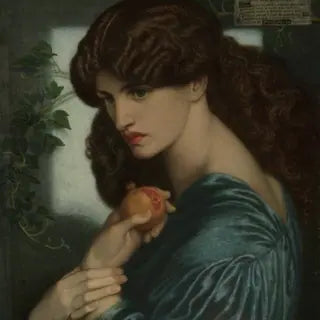
Persephone is the daughter of Demeter and the wife and queen of Hades. The title Kore means maiden or daughter, while underworld sources give her sovereign authority among the dead. These identities coexist rather than describing a passive spring figure who becomes important only through Hades.
The Homeric Hymn to Demeter
The hymn tells how Hades takes Persephone, how Demeter withdraws fertility from the earth, and how divine negotiation produces a divided year after Persephone eats pomegranate seed. It is also a foundation story for Demeter’s connection with Eleusis.
Persephone and the seasons
The story connects grain, absence, return, death, and renewal, but it should not be reduced to a universal diagram of winter and spring. Mediterranean cultivation cycles and the timing of Greek festivals do not map neatly onto every modern northern climate.
Queen of the underworld
In myth and cult Persephone can receive the dead, witness oaths, respond to heroes, and share rule with Hades. Calling her only a captured maiden hides this enduring authority.
Eleusinian Mysteries
Demeter and Persephone stood at the center of the Eleusinian Mysteries. Initiates kept important rites secret, so modern reconstructions must distinguish public evidence from speculation.
Modern reception
Persephone has become a figure for trauma, autonomy, descent, return, grief, and transformation. These interpretations can be meaningful when they are identified as modern readings rather than the only ancient meaning.
Persephone symbols
These symbols come from texts, cult titles, art, ritual objects, or later reception. Their evidence is not equal, and no attribute should be identified without context.
- pomegranate
- torch
- grain and sheaves
- flowers and meadow
- crown and sceptre
- underworld throne
Related guides in this cluster
- Persephone and Hades: The Abduction, Pomegranate, and Ancient Meaning
- Persephone Symbols: Pomegranate, Torch, Grain, and Flowers
- Persephone and Demeter: Eleusinian Mysteries, Grain, and Seasonal Return
Related symbols and products
No product is presented here as an ancient sacred object merely because it shares a color, stone, or aesthetic. Related workshop items will be added only when the symbolic connection is explicit and responsibly labelled.
Frequently asked questions
What is Persephone the goddess of?
Persephone is queen of the underworld and is closely linked with Demeter, grain, return, and the Eleusinian Mysteries.
Did Persephone marry Hades?
Ancient myth presents Persephone as Hades’ wife and underworld queen, while the Homeric Hymn also makes her abduction central to Demeter’s grief.
Why did Persephone eat pomegranate seeds?
In the Homeric Hymn, eating the seed creates the condition for her recurring return to the underworld.
Is Persephone a spring goddess?
Spring and renewal are important modern interpretations, but ancient evidence more broadly concerns grain, absence, return, death, and mystery worship.
Sources and further reading
Last reviewed: July 27, 2026. Ancient evidence, scholarly interpretation, and modern Pagan practice are distinguished throughout.
Kore, Persephone, and the Queen Below
Kore means “maiden” or “daughter” and often names Persephone in cultic contexts, especially in relation to Demeter. “Persephone” itself has several ancient spellings and an uncertain etymology. The two names do not describe two separate goddesses: they emphasize different relationships and settings within a complex divine identity.
As Demeter’s daughter, Persephone is the lost and returning Kore. As wife of Hades, she is a queen who receives the dead and can act with underworld authority. Greek texts can call on her with reverence and fear. Reducing her either to a helpless spring maiden or to a modern romantic “dark queen” erases half the evidence.
The Homeric Hymn to Demeter
The fullest early narrative tells how Hades seizes Persephone with Zeus’s authorization, how Demeter searches and withholds fertility from the earth, and how a settlement establishes Persephone’s movement between realms. The pomegranate seeds bind her to the underworld. The poem focuses on Demeter’s grief, divine power, famine, negotiation and the establishment of rites at Eleusis; it is not primarily a love story between Persephone and Hades.
Persephone’s agency varies within the poem and across later sources. Responsible retellings should retain the violence of the abduction while also recognizing that later cult and literature present her as a durable sovereign among the dead.
Eleusis, local cults, and mystery
At the Eleusinian Mysteries, Demeter and Persephone stood at the center of initiation. Participants were sworn to secrecy, so modern reconstructions of the exact revelation remain uncertain. Ancient testimony nevertheless connects initiation with hope, blessing and a changed relationship to death. The sanctuary’s long history also means that practice developed across Archaic, Classical, Hellenistic and Roman periods.
Southern Italian evidence adds other perspectives. The pinakes from Locri show Persephone enthroned, receiving worship and participating in imagery of marriage and transition. Orphic or Bacchic gold tablets from graves sometimes address Persephone among underworld powers. These objects reveal that her cult was larger than one Athenian festival.
Does Persephone explain the seasons?
The myth is often summarized as winter beginning when Persephone descends and spring arriving when she returns. The Homeric Hymn certainly links her absence with failed crops and return with restored fertility. Yet a simple four-season diagram can be misleading in a Mediterranean climate, where the dry summer is also agriculturally harsh. Ancient ritual calendars and local farming cycles were more complex than a universal “six months of winter” formula.
Continue the learning path