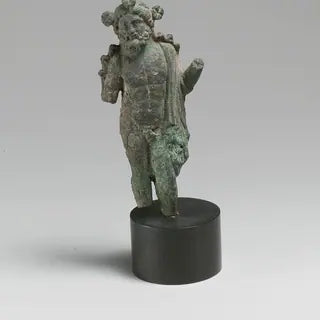
Thor (Old Norse Þórr) is the thunder god and one of the most widely recognized figures of Norse tradition. Medieval poems make him the tireless defender of gods and humans against threatening giants and the world-serpent Jörmungandr. Archaeology adds another dimension: hammer pendants, names and inscriptions show that Thor mattered beyond storytelling, especially during the Viking Age and the conversion to Christianity.
Thor at a glance
| Tradition | Old Norse and wider Germanic religion |
|---|---|
| Old Norse name | Þórr; related to continental Germanic Donar/Thunar |
| Domains | Thunder, storms, protection, strength, sanctification and agricultural well-being |
| Family | Son of Odin and Jörð; husband of Sif; father of Þrúð, Magni and Móði in surviving traditions |
| Attributes | Hammer Mjölnir, iron gloves, strength-belt, goat-drawn chariot |
Evidence note: The Eddas are indispensable but late. Hammer amulets, place-names and inscriptions help compare literary Thor with the god encountered in Viking Age religious life.
Thor’s name, family and place among the gods
Thor’s name is connected with thunder, and the English Thursday preserves “Thor’s day.” He belongs to the Æsir. The main sources call Odin his father and Jörð, “Earth,” his mother. His wife Sif is famous for her golden hair, while his children appear in several poems and myths. Modern entertainment often makes Loki Thor’s adopted brother; the medieval sources do not.
Thor is not merely a subordinate warrior serving Odin. His role is different. Odin often seeks hidden knowledge and works through strategy, disguise or elite networks. Thor confronts threats physically and protects the ordered world. Explore that larger divine setting in the Norse Pantheon guide.
What is Thor the god of?
Thunder and storms
Thor’s chariot, hammer and battles explain the noise and violence of storms in mythic language. Lightning is strongly attached to him in modern summaries, while the medieval sources focus especially on thunder, striking force and Mjölnir’s power.
Protection and the boundaries of the world
Thor repeatedly fights jötnar and monsters who threaten the gods’ world. “Giants” are not a single moral race identical to evil; they are a diverse category, and the gods themselves have jötunn ancestry and relationships. Thor’s protective function lies in maintaining a habitable order, not in a simple battle of good against evil.
Fertility, hallowing and ordinary life
Mjölnir is used not only to destroy but also to bless and restore. In Þrymskviða, the hammer is placed in a bride’s lap to hallow the marriage. Thor’s goats can be killed for food and restored if their bones are treated correctly. These details connect his force with continuity, food, household welfare and life renewed.
Mjölnir: weapon, sacred object and amulet
Mjölnir returns to Thor’s hand after being thrown and is his chief defense against cosmic enemies. Its name has uncertain etymology, and confident claims that it literally means one specific phrase should be treated cautiously.
Hundreds of hammer-shaped pendants are known from the Viking Age. Some may have declared allegiance to Thor during contact with Christianity, while others could express protection, identity, family custom or status. A pendant’s meaning depended on wearer and setting; archaeology does not let us read every personal intention.
For readers who want a physical reminder after studying the history, Pagan Workshop makes a Mjolnir Necklace in several materials. The product is a modern handcrafted interpretation, not an archaeological replica.
Major myths about Thor
The stolen hammer
In Þrymskviða, the jötunn Þrymr steals Mjölnir and demands Freyja as his bride. Heimdall proposes disguising Thor as Freyja; Loki accompanies him. Once the hammer is brought out to consecrate the wedding, Thor seizes it and destroys the hostile wedding party. The poem combines religious imagery with comedy, disguise and restored order.
Fishing for Jörmungandr
Thor rows into deep water with Hymir, uses an ox-head as bait and hooks the world-serpent. The encounter anticipates Ragnarök. Versions differ on whether Thor strikes the serpent before it escapes, reminding us that Norse myths were not fixed by one canonical edition.
Útgarða-Loki’s contests
Thor fails apparently simple tests because each conceals a cosmic scale: the drinking horn is connected to the sea, the cat is Jörmungandr, and the old woman is age itself. The story does not merely ridicule him; it measures his strength against forces no one can finally overcome.
Ragnarök
Thor kills Jörmungandr but walks only nine steps before dying from its venom. His sons Magni and Móði survive and inherit Mjölnir, placing the hammer in the renewed world beyond catastrophe.
Thor in worship, names and archaeology
Thor’s popularity is visible in personal names, place-names, hammer amulets and runic inscriptions asking him to hallow or protect. Written accounts of temples and sacrifice were often recorded by Christian authors and need comparison with archaeology. The evidence points to a god relevant to farmers, travelers, households and communities as well as warriors.
Thor in modern Heathenry and popular culture
Modern Heathens may honor Thor as protector, storm god, friend of humankind or guardian of community. Popular culture has created a separate modern mythic character with different appearance and relationships. Both are culturally real, but they should not be confused when discussing historical religion.
Frequently asked questions
Was Thor red-haired?
Later literary tradition commonly presents him as red-bearded. Visual details vary, and archaeology rarely labels a figure clearly enough to settle appearance.
Is Mjölnir only a weapon?
No. In myth it can kill, protect, restore and consecrate. Hammer amulets also show its role as a worn sign.
Are Thor and Zeus the same god?
No. Both are linked with thunder, but they belong to different languages, myths, cults and social histories.