
Ereshkigal is a Mesopotamian goddess who rules the underworld. Her name is commonly translated as “Lady of the Great Earth.” To understand her, start with the surviving texts rather than a modern list of crystals, animals, or sigils: her authority in myth is clearer than a single universally identifiable visual emblem.
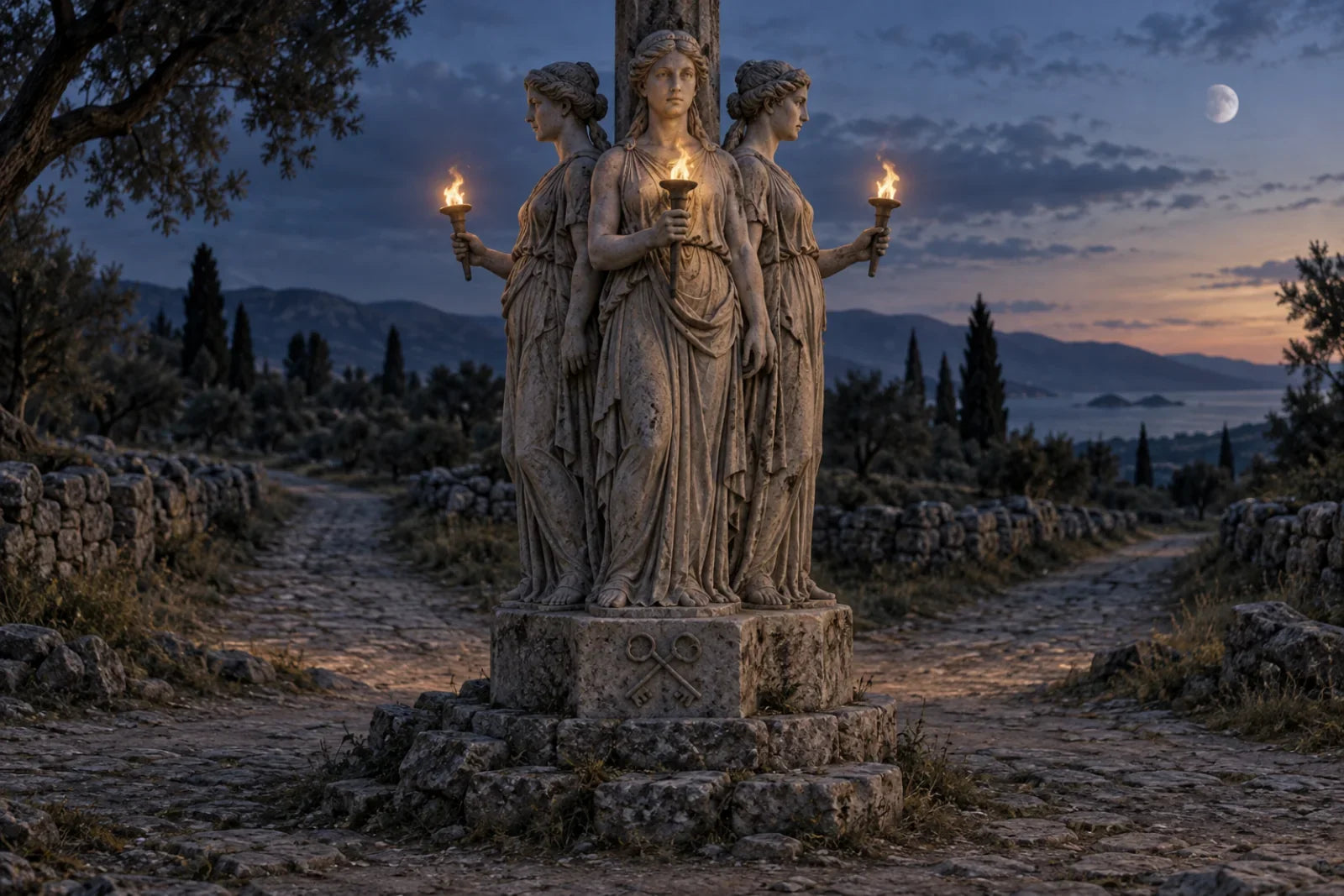
Header image: AI-generated editorial illustration of an imagined underworld. It is not an archaeological reconstruction, an ancient artifact, or a historical portrait of Ereshkigal.
Who is Ereshkigal?
The scholarly ORACC overview by Yağmur Heffron identifies Ereshkigal as the ruler of the underworld and discusses her relationships with other deities. You may see her name written as Ereškigal or, in older transliteration systems, Erec-ki-gala. These spelling differences can make the same figure look unfamiliar across translations.
Her office matters: she is a ruler with authority over a realm, not merely a decorative personification of darkness. For a wider introduction to the surrounding divine world, see our Mesopotamian pantheon guide.
Why there is not one neat mythology
Mesopotamian religion extended across different cities, languages, and periods. The Metropolitan Museum’s introduction to Mesopotamian deities emphasizes that there was no single systematic theological account describing all the gods. It presents the underworld as a realm administered by Ereshkigal, Nergal, and their household.
That context helps explain why combining every family tree or story into one seamless biography can be misleading. Ask which text is being summarized, and whether the source describes a literary episode, a cult practice, or a modern interpretation. “In this version” is often a more accurate phrase than “the Mesopotamians believed” without qualification.
A source-based introduction can leave a detail unresolved. Uncertainty is useful information when a confident answer would require blending different traditions.
Ereshkigal in Inanna’s Descent
In the Sumerian Inana’s Descent to the Netherworld, Ereshkigal is the sister whose realm Inanna enters. The seven gates impose a progressive loss of Inanna’s clothing and regalia. Inside, the encounter leads to judgment and death; Enki’s intervention later makes her revival possible, but departure comes with the demand for a substitute.
The surviving translation includes a striking scene in which Enki’s helpers respond to Ereshkigal’s distress. This complicates any reading of her as nothing more than a one-dimensional villain. Our interpretation is that the story asks a reader to pay attention both to the boundaries of her realm and to suffering within it.
This is a brief account of the Sumerian composition, not a merged retelling of every descent story. Begin with the translated text and its indicated variants before attaching a modern psychological scheme to each gate. For the visiting goddess’s wider context, read What Is Inanna Famous For?.
Ereshkigal and Nergal
Nergal is associated with Ereshkigal as her consort in later tradition. ORACC’s Nergal entry notes that this marriage is a relatively late development among his divine relationships. Its account of Nergal and Ereshkigal describes his journey below after an offense against her minister Namtar.
This is a useful warning against beginning every discussion of Ereshkigal by defining her only as someone’s wife. The relationship has a history; it is not the only framework through which her authority can be understood.
It also matters which version of a narrative you read. A summary that turns a difficult myth into a straightforward modern romance can conceal tensions in the source. Read the cited scholarly discussion and translation context rather than assuming all retellings tell an identical story.
What was the Mesopotamian underworld?
The Met’s educational publication Art of the Ancient Near East describes a netherworld populated by the spirits of the dead and represented in literature through darkness and mourning. Such imagery belongs to the sources’ ideas about death; it should not automatically be translated into the categories of a later religion.
Calling Ereshkigal a “goddess of hell” may seem convenient, but it can bring in assumptions about punishment and moral judgment that need their own evidence. “Queen of the underworld” is a clearer starting description. It identifies her domain without pretending that all cultures imagined death in the same way.
Ereshkigal symbols: what can we actually say?
A meaningful modern image is not necessarily a documented ancient identifying symbol. For Ereshkigal, be particularly cautious about claims that an owl, a specific crystal, or a newly drawn sigil is her universally established emblem.
ORACC’s discussion notes that the owls in the disputed Burney relief do not have a secure textual connection with Ereshkigal or the netherworld. That weakens the common shortcut “owl equals Ereshkigal.” A contemporary artist may still choose an owl, but should describe that choice as an interpretation rather than proof.
When assessing a claimed symbol, use three questions:
- Is there a named, dated object or a cited ancient text?
- Does that source identify Ereshkigal, or is the identification an argument?
- Is the modern design actually the same image as the source, or just loosely inspired by it?
These questions help distinguish an ancient attribute, a debated attribution, and an artist’s new visual language.
Is the Queen of the Night relief Ereshkigal?
The British Museum’s Queen of the Night object record concerns an Old Babylonian clay relief with a winged female figure, lions, and owls. Its bibliography reflects a long discussion of the figure’s identification. It should not be captioned as an unquestionable portrait of Ereshkigal.
The museum’s introduction to its Feminine Power exhibition describes the figure as widely considered to represent Ishtar. This is an important counterweight to online captions that present only the Ereshkigal attribution.
A careful caption can name the object and state that identification is debated. It does not need to erase the object’s interest by pretending a difficult scholarly question is settled. Nor should the relief be used to collapse Ereshkigal, Ishtar, and Lilith into one interchangeable figure.
Reading Ereshkigal today
You may find the stories useful for thinking about limits, grief, authority, or the loss of familiar status. Those are contemporary interpretive possibilities, not instructions preserved in a tablet for modern self-help.
A thoughtful reading exercise is to make two columns in a notebook: “What the text says” and “What it brings to mind for me.” Keeping them separate allows a personal response without turning it into a historical claim.
A visually dark pendant or an owl design is not, by appearance alone, an Ereshkigal object. If you choose an artwork for personal devotion, keep the maker’s stated inspiration distinct from archaeological identification.
Continue exploring
Sources and further reading
- Yağmur Heffron, ORACC: Ereshkigal - name, relationships, and iconographic questions.
- University of Oxford, ETCSL: Inana’s Descent - translated Sumerian composition.
- ORACC: Nergal - divine relationships and myth.
- The Metropolitan Museum of Art: Mesopotamian Deities - religious context.
- The Met: Art of the Ancient Near East - educational discussion of the afterlife.
- British Museum: Queen of the Night - collection record and bibliography.
- British Museum: An Introduction to Feminine Power - an Ishtar attribution in the museum’s interpretation.
Ishtar / Inanna pieces from the workshop
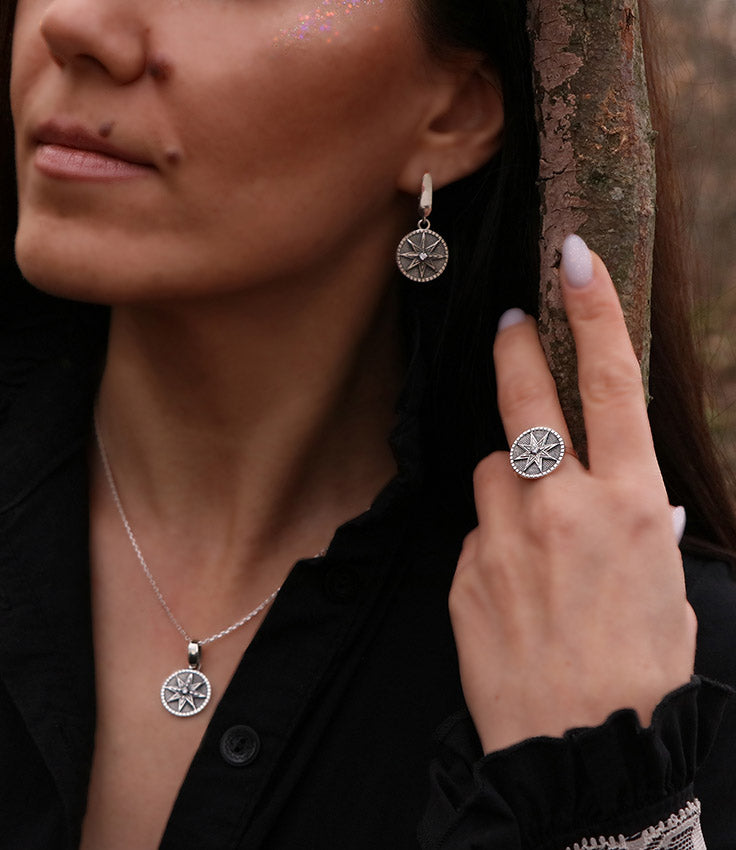
Inanna’s descent connects her story with Ereshkigal’s realm, but the two goddesses are not interchangeable. The pieces below are contemporary Pagan Workshop designs inspired by Ishtar / Inanna, not representations of Ereshkigal or archaeological reproductions.
Explore the star pendant, adjustable ring, sterling-silver earrings, and wooden candle holder. Each card opens the product page for materials, options, and ordering details. For a no-flame display with the wooden holder, choose a suitably fitting LED candle.
Myth meets the workshop
Two worlds. Two goddesses.
Explore the story. Discover the pieces inspired by Inanna / Ishtar.

Inanna / Ishtar
The goddess who descends. Her eight-pointed star inspires these contemporary pieces.
Ereshkigal
The queen who rules below. In the Sumerian descent story, Inanna enters her sister’s realm.
A threshold between two realms - not two names for one goddess.
Original Pagan Workshop design
Star of Ishtar Necklace - Handmade Inanna Eight-Pointed Star Pendant
From $27.00
Original Pagan Workshop design
Adjustable Ishtar Ring
From $25.00
Original Pagan Workshop design
Ishtar/Inanna Earrings – Sterling Silver
$85.00
Related stories. Distinct goddesses.
Ereshkigal rules the underworld; Inanna enters it. The jewelry shown here is inspired by Inanna / Ishtar, not an ancient emblem of Ereshkigal or an archaeological reproduction.