

Reviewed and updated Jul 19, 2026
There is no reliable ancient evidence that Hecate specifically liked, preferred, or required black obsidian. Its connection with her is primarily a modern Pagan and witchcraft correspondence based on shared themes: darkness, reflection, boundaries, protection, divination, and personal transformation.
Using obsidian in a modern Hecate practice can still be meaningful. Historical accuracy does not require rejecting contemporary symbolism; it requires describing the connection honestly and avoiding claims that a personal correspondence was an ancient rule.
Does Hecate like black obsidian?
A devotional preference grows through repeated offering, attention, dreams, ritual response, and the meaning the material gathers within the relationship. Ancient sources and surviving cult evidence do not identify black obsidian as Hecate's favored stone. Statements such as “Hecate loves obsidian” belong to personal experience or a modern tradition, not to a universally documented historical practice.
A practitioner may still choose obsidian as an offering or devotional object. The clearest phrasing is: “I use black obsidian to represent protection or reflection in my practice with Hecate,” rather than “the ancient Greeks knew obsidian was sacred to Hecate.”
What is black obsidian?
Obsidian is naturally occurring volcanic glass. It forms when silica-rich lava cools so quickly that crystals do not have time to grow. Although it is commonly called a crystal in metaphysical shops, it is technically glassy volcanic rock rather than a mineral crystal.
Obsidian often appears black or very dark and breaks with a curved, conchoidal fracture. That fracture can create extremely sharp edges. Its reflective surfaces and dramatic geological origin have made it a compelling material for tools, ornaments, mirrors, and symbolic objects in different cultures.
Why is black obsidian associated with Hecate today?
Darkness and night
The stone's dark appearance is visually compatible with modern images of Hecate as a goddess of night, mystery, spirits, and hidden knowledge. Color resemblance is symbolic, however; it is not historical proof.
Reflection and self-examination
Polished obsidian can have a mirror-like surface. Some practitioners use that quality for meditation, scrying, journaling, or what contemporary spiritual communities call shadow work. In this setting, the object helps focus attention; it does not guarantee supernatural information.
Boundaries and protection
Modern crystal systems often assign obsidian protective or banishing meanings. These ideas resonate with Hecate's historically stronger roles at gates, doorways, and crossroads. The connection grows naturally from her boundary symbolism, giving obsidian a strong place in present-day rites of gates, doorways, crossroads, and transformation.
Transformation
Obsidian's formation from rapidly cooled lava provides a vivid image of change from molten material to glass. Practitioners may use it to mark a decision, an ending, or a new phase at a personal crossroads.
Is there historical evidence for Hecate and obsidian?
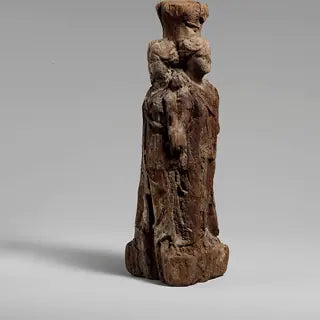
Greco-Roman religious and magical practice included engraved gems and amulets, and some surviving objects represent Hecate. That evidence demonstrates that images of the goddess could appear on small ritual objects. For modern devotees, black obsidian can become a particularly strong material for meeting her protective and liminal aspects.
To make a historical claim, an object would need secure identification of the material, figure, date, origin, and use. A general reference to ancient magical gems cannot be converted into a claim that all black stones-or obsidian specifically-belonged to Hecate.
For the broader comparison of black obsidian, moonstone, labradorite, jet, and other current correspondences, read Hecate Stones and Crystals: History, Modern Associations, and Practice.
Ways to use black obsidian in modern Hecate practice
- Place a polished piece near a key or doorway image as a reminder of personal boundaries.
- Hold it while journaling about a choice, fear, or transition.
- Use an obsidian-colored object to mark the beginning and end of meditation.
- Wear it as a personal symbol of vigilance or a commitment already made.
- Place it on an altar as a contemporary offering, then reuse it respectfully when the devotional period ends.
No special object is required to honor Hecate. A dark glass bead, ordinary stone, written intention, key, torch image, or act of caring for a physical threshold can serve a similar symbolic purpose.
Physical and spiritual safety
Raw or broken obsidian can be sharper than it looks. Handle fractured pieces carefully, keep them away from children and animals, and do not place loose fragments where they can be stepped on. Use a stable stand for an obsidian mirror or sphere.
Claims that obsidian absorbs measurable negative energy, removes trauma, or treats illness are spiritual beliefs, not established medical effects. Intense self-examination can be emotionally difficult; pause when needed and seek qualified mental-health support for trauma or distress.
Avoid assuming that every owl call, dream, broken stone, or accidental reflection is a message from Hecate. Personal interpretation is possible, but ordinary causes and your own wellbeing should remain part of the assessment.
Frequently asked questions
Is black obsidian Hecate's sacred stone?
It is a popular modern correspondence, not a securely documented universal sacred stone from ancient Greek worship.
Can black obsidian be offered to Hecate?
Yes, in modern personal devotion. State the intention in your own terms and do not feel obligated to discard or bury the object afterward.
Does obsidian protect against negative energy?
Protection is a metaphysical interpretation. Obsidian can act as a meaningful reminder of boundaries and caution, but it should not replace practical safety measures.
Can I use an obsidian mirror for scrying?
Some modern practitioners do. Treat the practice as meditation or symbolic divination, use a stable setup, and avoid presenting impressions as guaranteed facts about the future.
What if I do not own obsidian?
Nothing is missing from your practice. Hecate devotion does not require a particular stone, purchase, or collection.
For Hecate's wider history and symbols, return to Hecate: Goddess of Magic, Crossroads, Keys, and the Night.
Continue exploring
From the workshop