

Artemis is a Greek goddess of hunting, animals, wild and marginal landscapes, girls’ transitions, and childbirth. Her later lunar identity is important, but treating her only as a “moon goddess” obscures the local sanctuaries and social thresholds that shaped ancient worship.
Explore this figure in the interactive Gods & Goddesses Atlas.
At a glance
- Culture: ancient Greek
- Parents: Zeus and Leto; twin: Apollo.
- Roles: hunting, wild animals, girls’ maturation, protection in childbirth, sudden death, and boundaries between wild and settled life.
- Major cult forms include Artemis Brauronia, Orthia, Ephesia, Agrotera, and Limnatis.
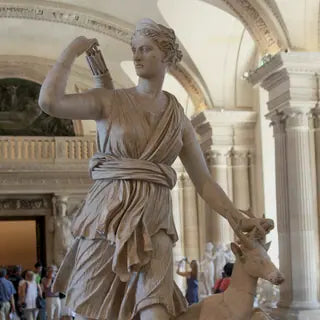
- Attributes: bow, quiver, deer, hunting dogs, wild animals, short hunting dress, torches, and later crescent imagery.
Birth, Leto, and Apollo
Artemis and Apollo are the children of Zeus and Leto. Hymns and later narratives differ about their birthplace and the order of the twins’ births. Delos became a major center of the birth tradition, while Ortygia and other places also claimed connections.
Twinship links Artemis to Apollo without making them simple female and male copies. Both can send sudden death and protect young people, but their cults, spaces, and local titles developed distinct histories.
Mistress of animals and the hunt
Artemis moves between wilderness and city. She protects animals yet also presides over hunting, a tension visible in Greek religion rather than a contradiction modern readers must erase. Successful hunting required limits, skill, and acknowledgment that wild life was not owned without obligation.
Art can show her as potnia theron, mistress of animals, holding or flanked by creatures. This older visual pattern is broader than Artemis alone, so identification depends on period, location, and accompanying attributes.
Girls, childbirth, and transition
At Brauron in Attica, girls performed rites associated with the “bears” of Artemis. Interpretation is debated, but the sanctuary clearly joined the goddess to childhood, maturation, textile offerings, and the risks of female life.
Although Artemis is famously unmarried, she protects childbirth. Greek divine roles do not follow modern biographical logic: a goddess need not be a mother to oversee dangerous transitions of mothers and children.
Actaeon, Iphigenia, Orion, and other myths
Actaeon sees Artemis bathing and is transformed into a stag before being killed by his own dogs. Versions differ about whether the offence is accidental sight, boasting, or rivalry. Iphigenia’s story likewise varies: Artemis may demand sacrifice, substitute a deer, rescue the girl, or receive her into service.
Stories of Orion range from companionship to attempted violence and death by scorpion or by Artemis herself. These contradictions show why myth is not a single biography assembled from all surviving episodes.
Ephesus, Diana, and lunar identity
Artemis of Ephesus had a distinctive Anatolian cult image and urban sanctuary. Her appearance and functions should not be forced into the mold of the youthful Greek huntress.
Roman Diana was deeply identified with Artemis, while retaining Italian sites and political meanings such as the sanctuary at Aricia. Lunar associations strengthened over time through links with Selene, Hecate, and Diana, but they never exhaust Artemis’s identity.
Symbols and identification
The bow, quiver, deer, hunting dogs, wild animals, torches, and short dress reliably identify many images of Artemis. The crescent is especially important in later art. The many rounded forms on the Ephesian statue are debated; confident internet claims that they are definitively breasts or bull testicles go beyond the evidence.
Modern Pagan reception
Modern devotion may connect Artemis with habitat protection, bodily autonomy, responsible boundaries, survival skills, and care during life transitions. Ethical practice should take the tension between hunting and conservation seriously.
Avoid claiming that every crescent belongs to Artemis or that all local forms were one uniform moon cult. Ancient titles and sanctuaries deserve their own context.
Continue exploring
- Greek Pantheon: gods, goddesses, family tree, and symbols
- Athena: wisdom, war, weaving, and the city
- Explore related Hecate guides
Frequently asked questions
Is Artemis the goddess of the Moon?
She developed strong lunar associations, especially in later Greek and Roman reception, but her older and broader roles concern hunting, animals, girls, childbirth, and wild boundaries.
Why is Artemis associated with childbirth?
Greek worship connected her with dangerous transitions of girls, mothers, and infants; divine responsibility did not require her to be a mother.
Is Artemis the same as Diana?
They were closely identified, but Diana also had distinct Italian and Roman cult traditions.
What happened to Actaeon?
He was transformed into a stag and killed by his hounds after offending or witnessing Artemis; ancient versions differ about the precise offence.
Sources and further reading
Last reviewed: August 1, 2026. Ancient evidence, later reception, and modern practice are labelled separately.