

Reviewed and updated Jul 19, 2026
Hecate belongs first to ancient Greek religion, although scholars continue to discuss the extent of her earlier Anatolian or Carian background. She was part of a polytheistic religious world rather than the founder of a separate “Hecate religion.” Her worship varied by place and period: household guardian, goddess at crossroads, helper in transition, civic patron, and later an increasingly important figure in magical and theurgical traditions.
Today, Hecate is honored in several different modern settings, including Hellenic polytheism, reconstruction-oriented practice, Wicca, eclectic Paganism, Goddess Spirituality, and individual devotional witchcraft. These contemporary paths are not interchangeable, and none can speak for every person who honors her.
What religion is Hecate from?
The simplest answer is ancient Greek polytheism. Greek sources treat Hecate as a goddess within a larger pantheon that included Zeus, Demeter, Persephone, Artemis, Hermes, and many other deities. Religious life was organized through households, cities, sanctuaries, festivals, offerings, local customs, and shared myths-not through one scripture or a membership-based denomination centered on Hecate alone.
Calling her only “the goddess of witchcraft” gives a narrow picture. Magic became an important part of her later reception, but earlier evidence also presents authority over transitions, prosperity, protection, childbirth, households, roads, and access between spaces.
Hecate in ancient Greek religion
Hesiod's Theogony, composed around the late eighth or early seventh century BCE, gives Hecate an unusually honored position. Zeus allows her to retain wide-ranging privileges, and she can assist in areas including wealth, victory, judgment, seafaring, herding, and the raising of children. This early portrait is broader and more benevolent than the later stereotype of a dark witch goddess.
In the Homeric Hymn to Demeter, Hecate hears Persephone's abduction, helps Demeter seek information, and later becomes Persephone's companion. The episode contributes to her role as a guide around transitions and boundaries, but it does not make her simply the ruler of the underworld.
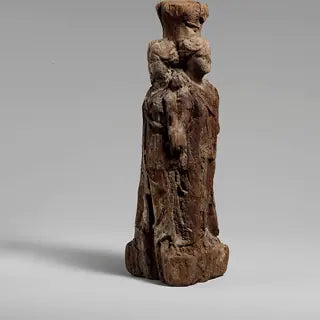
Images and small shrines of Hecate could stand near entrances and crossroads. Offerings made in these spaces belonged to the religious life of the household and community. Her position at a boundary could be protective, uncertain, or both.
Did Hecate have temples and organized worship?
Yes, but her cult was not identical everywhere. Pausanias describes an annual rite and sanctuary on Aegina with a single-bodied cult image. Athens had doorway and crossroads images as well as the famous triple figure associated with Alcamenes.
The most important monumental sanctuary stood at Lagina in Caria, within the territory of Stratonikeia. There Hecate occupied an unusually prominent civic role. Festivals, inscriptions, processions, sculpture, and coin imagery connected the goddess with the political and communal identity of the city. The Procession of the Key was a public institution, not merely a private magical rite.
This local diversity matters. An Athenian household image, an Aeginetan sanctuary, and the civic goddess of Lagina belonged to related religious worlds, but their practices and emphasis were not necessarily the same.
Hecate in later Greek and Roman traditions
As Greek and Roman cultures interacted, Hecate's identity continued to develop. She could be associated with Artemis, Selene, Persephone, or the Roman Trivia without becoming completely identical to any one of them. Literary works increasingly emphasized night, ghosts, magic, and the underworld.
Greco-Roman magical texts, engraved gems, and later philosophical or theurgical traditions gave Hecate additional cosmic and ritual roles. These sources are important, but they come from particular periods and communities. Late-antique magical invocations reveal another powerful stage in Hecate’s worship, shaped by the particular communities and ritual worlds that preserved them.
What religions worship Hecate today?
Hellenic polytheism
Some modern Hellenic polytheists honor Hecate within a revival or reconstruction of ancient Greek religion. Practices vary: one group may prioritize historical sources and household ritual, while another combines scholarship with new theology and contemporary needs.
Wicca
Some Wiccans honor Hecate, often through lunar, magical, or Triple Goddess symbolism. She is not required in every Wiccan tradition, and the Maiden-Mother-Crone framework is a modern model rather than the ancient explanation of her triple images.
Eclectic Paganism and devotional witchcraft
Eclectic Pagans and independent practitioners may combine historical study with modern ritual, personal experience, ancestor work, divination, or witchcraft. Such practices can be sincere without being reconstructions of an ancient cult. Clear labeling helps readers understand which elements are documented, adapted, or personal.
Goddess Spirituality and other modern paths
Hecate also appears in Goddess Spirituality, feminist religious movements, occult traditions, and individual forms of devotion. These paths may interpret her as an archetype, autonomous deity, cosmic power, or symbol of transformation. There is no single modern institution that controls all Hecate worship.
Frequently asked questions
Is Hecate Greek or Roman?
She is primarily a goddess of ancient Greek religion, with possible Anatolian or Carian background. Romans later received and reinterpreted her within their own religious and literary culture.
Is Hecate a Wiccan goddess?
She predates Wicca by more than two millennia. Some Wiccans honor her today, but Wicca did not originate her worship and does not have exclusive authority over it.
Was ancient Hecate worship witchcraft?
Not as a complete description. Ancient religion, household protection, civic cult, offerings, magic, and later theurgy overlapped in complex ways. Reducing every form of worship to modern witchcraft loses that context.
Do modern devotees have to practice exactly like ancient Greeks?
No universal rule applies across modern communities. Reconstruction-oriented practitioners may stay close to historical evidence, while eclectic devotees may create new forms. The key editorial distinction is to identify what is ancient evidence and what is modern adaptation.
Is there one official way to worship Hecate?
No. Ancient worship itself varied locally, and modern traditions differ even more. Historical study, respect for living communities, personal boundaries, and honest sourcing provide a stronger foundation than claims of one secret universal method.
For the complete overview of her history, powers, and symbols, return to Hecate: Goddess of Magic, Crossroads, Keys, and the Night.
From the workshop