Reviewed and updated Jul 19, 2026
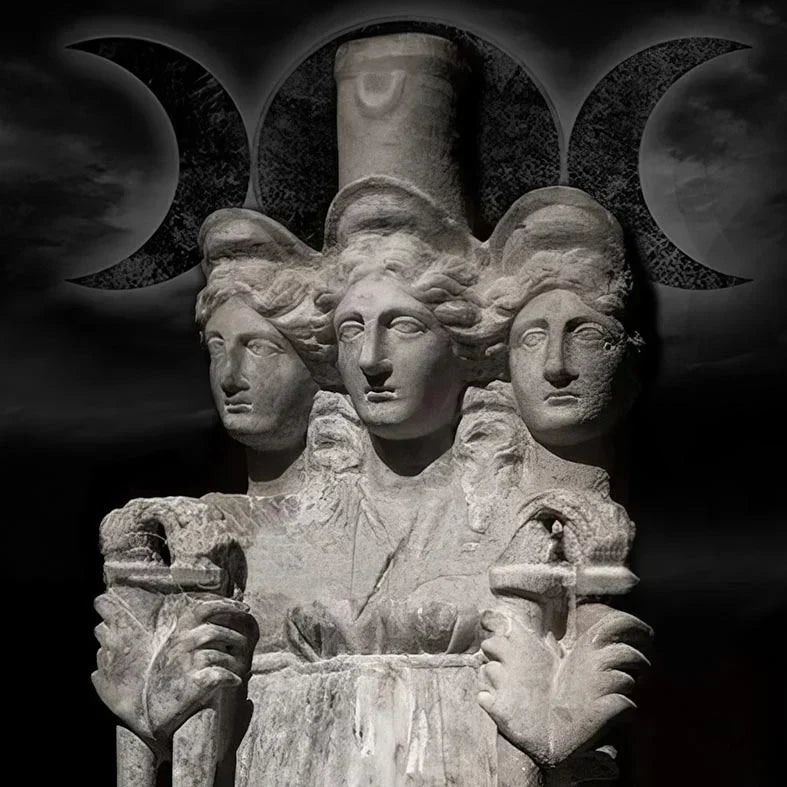
Hecate's three forms originally refer to ancient images that show the goddess as three figures joined together or facing in three directions. This iconography suited a deity associated with crossroads, entrances, boundaries, and movement between spaces. It did not originally mean Maiden, Mother, and Crone.
Many modern Pagan traditions do interpret Hecate through the Maiden-Mother-Crone framework or connect her three forms with lunar phases, past-present-future, and birth-life-death. These can be meaningful contemporary spiritual readings, but they should be distinguished from the surviving evidence for ancient Greek worship.
What are Hecate's three forms?
In ancient art, triple Hecate could appear as three full figures arranged around a central support, each looking in a different direction. Later representations sometimes condensed this idea into one body with three heads or faces. Such images are often called hekataia.
The three figures were not necessarily three different ages or three separate personalities. They presented one goddess in a form able to watch several approaches at once. The precise objects held by the figures vary across surviving images and may include torches, keys, vessels, cords, serpents, or other attributes.
What does the ancient evidence say?
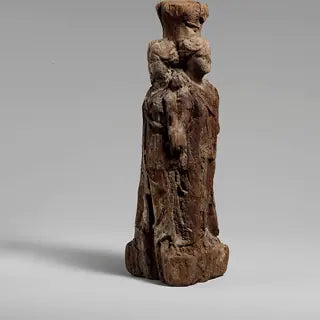
The Greek travel writer Pausanias provides an especially useful comparison. When describing Hecate's sanctuary on Aegina, he says that its wooden cult image by Myron had one face and one body. He then credits the sculptor Alcamenes with making three images of Hecate joined together in Athens. Pausanias' account shows that Hecate could be represented in both single and triple form; triplicity was important iconography, not a rule applied to every image of the goddess.
Alcamenes worked in the fifth century BCE, and the triple image Pausanias mentions stood near the temple of Athena Nike on the Athenian Acropolis. Other hekataia were placed at boundaries and entrances. Their form made visual sense where paths, doorways, or territories met.
Ancient literary and visual evidence does not identify the three figures as Maiden, Mother, and Crone. Nor does it give a universal label to each direction or face. When a modern chart assigns one face to the past, one to the present, and one to the future, it is offering an interpretation rather than translating a standard ancient doctrine.
Why is Hecate shown threefold at crossroads?
A three-way junction demands awareness in several directions. A triple image can face each road, making Hecate a fitting guardian of the whole crossing. This reflects her broader connection with doorways, gates, borders, transitions, and places where a choice must be made.
The image should not be reduced to a literal traffic marker. Crossroads also carry religious and social meaning: they separate one territory from another, create uncertain spaces, and make movement or decision visible. Hecate's torches illuminate; her keys control access; her dogs warn and guard. The triple form brings this symbolic language together in a single image of watchfulness.
For a fuller treatment of this setting, read Hecate as goddess of crossroads and thresholds.
Is triple Hecate the Maiden, Mother, and Crone?
In some modern Pagan, Wiccan, and Goddess Spirituality traditions, yes: practitioners may understand Hecate through the Maiden-Mother-Crone pattern. The three aspects can represent youth and potential, creation and care, then age and accumulated wisdom. This threefold Goddess model became especially influential in the twentieth century and was popularized by writers including Robert Graves.
That modern framework should not be projected backward as the original explanation of ancient Hecate's three bodies. The ancient iconography and the modern spiritual model answer different questions. One concerns how a Greek goddess was represented at boundaries; the other provides a symbolic structure for life stages, nature, spirituality, and personal reflection.
Ancient image and contemporary interpretation can stand together: one preserves the many-faced goddess of crossroads and entrances, while the other lets devotees encounter her through moon phases, life stages, and sacred change.
Do the three forms represent moon phases, time, or life cycles?
Modern practitioners use several systems. Hecate's three forms may be associated with waxing, full, and waning moon; birth, life, and death; past, present, and future; or the three directions of a crossroads. These correspondences are not identical, and no single version is compulsory across modern Paganism.
Hecate did acquire strong lunar associations in later antiquity, especially through identification with other goddesses. Even so, the familiar modern Triple Moon symbol and the Maiden-Mother-Crone sequence offers a contemporary spiritual reading alongside the many possible meanings of the ancient hekataion.
A responsible reading asks two questions: “What does the historical source actually show?” and “What meaning does a modern community or individual draw from it?” Answering both makes the symbol richer and avoids turning a living tradition into false history.
Frequently asked questions
Was Hecate always depicted in triple form?
No. Pausanias explicitly describes a single-faced, single-bodied cult image on Aegina as well as a triple image associated with Alcamenes in Athens. Both forms existed.
Does Hecate have three different personalities?
Ancient triple images do not require three separate personalities. They represent one goddess in multiplied form. Modern devotional traditions may name or interpret three aspects differently.
Are the three faces past, present, and future?
This is a common modern symbolic reading, not a universally attested ancient explanation. It can be used as a personal or ritual framework when clearly identified as contemporary.
Why is Hecate sometimes shown with three heads instead of three bodies?
Artists used different ways to express the same basic idea of triplicity. Some works show three complete figures around a central support; others use one body with three faces or heads.
What is the best way to understand a modern Hecate symbol?
Look at its context. A museum object, a modern devotional image, and a jewelry design may use similar forms for different purposes. Identify what is historically documented, then consider the modern meaning stated by its maker or wearer.
For the complete overview of the goddess, return to Hecate: Goddess of Magic, Crossroads, Keys, and the Night.
From the workshop