
Reviewed and updated Jul 19, 2026
The short answer: a pentagram is the five-pointed star itself. In contemporary Pagan and Wiccan usage, a pentacle usually means that star enclosed by a circle or displayed on a disk. The two words have overlapped historically, however, so context matters.
This distinction is useful when discussing modern jewelry and Pagan symbolism, but it should not be projected unchanged onto every older text. Earlier ritual-magic sources used pentacle more broadly for a consecrated talisman or diagram, and not every historical pentacle contained a five-pointed star.
Pentacle vs pentagram at a glance
| Term | Common modern form | Common modern meaning |
|---|---|---|
| Pentagram | A five-pointed interlaced star | Balance, fivefold symbolism, the relationship between spirit and the material world |
| Pentacle | A pentagram within a circle, often shown on a disk or pendant | Those same fivefold meanings held within unity, wholeness, sacred space, or protection |
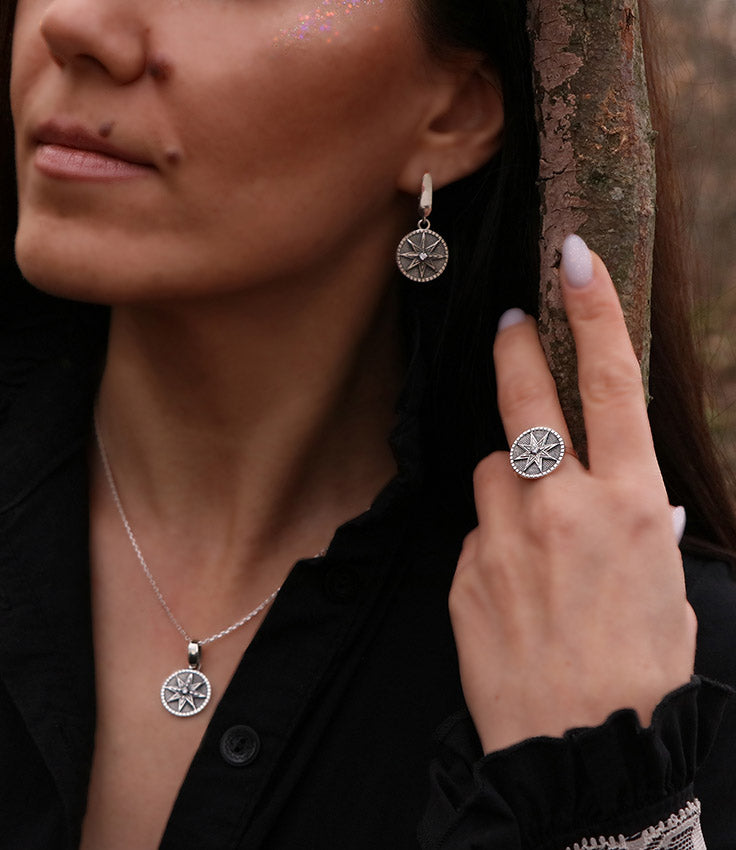
The easiest visual rule is therefore: the pentagram is the star; the modern Pagan pentacle is usually the star plus the surrounding circle.
What is a pentagram?
A pentagram is a five-pointed star drawn with five connected straight lines. It is a geometric figure before it is a religious symbol, and five-pointed stars have appeared in different cultures and periods with different meanings.
Because the pentagram can be drawn as one continuous line, it has often suggested connection, proportion, and an ordered relationship between parts. Later philosophical, magical, Christian, occult, Pagan, and popular traditions interpreted it in their own ways. There is no single meaning shared by every historical use.
For a broader historical overview, see our guide to the pentagram’s meaning, history, and symbolism.
What is a pentacle?
In modern Pagan and Wiccan contexts, a pentacle commonly means a pentagram enclosed within a circle. The circle may be understood as unity, continuity, a ritual boundary, the natural cycle, or the interdependence of the five points.
Historically, the word was broader. Dictionaries and ritual-magic sources also use pentacle for a talisman or disk carrying a sacred or magical design. Such a design might contain a pentagram, but it could contain other figures, names, letters, or seals. This is why an older book can call an object a pentacle even when it does not match the familiar modern “star in a circle” design.
Both usages are valid within their contexts:
- Modern Pagan usage: usually a circled pentagram.
- Historical ritual-magic usage: a consecrated talisman, disk, or diagram that may carry many kinds of designs.
- General dictionary usage: sometimes simply another word for pentagram.
Do the five points represent the elements?
Many modern Pagan, Wiccan, and Western esoteric systems associate the five points with earth, air, fire, water, and spirit. A common arrangement places spirit at the upper point and the four material elements around the remaining points.
This is an important contemporary interpretation, but it is not a universal explanation for every pentagram in history. Elemental correspondences depend on the tradition, author, ritual system, and orientation of the symbol. When reading an old object or text, its own cultural setting should come before a modern chart of correspondences.
To explore the elemental framework itself, read our guide to spirit, air, fire, water, and earth.
What does the circle add?
In the familiar modern pentacle, the circle visually joins and contains the star. Practitioners may interpret this as wholeness, protection, sacred space, the cycles of nature, or the unity of the elements. The circle does not create one mandatory meaning; it adds a boundary through which a community or individual can express relationship and integration.
For this reason, some people choose a pentacle when they want to emphasize protection or the elements acting as a whole, while others choose an uncircled pentagram to emphasize the star, geometry, or a particular fivefold teaching.
Does an upright or inverted pentagram change the meaning?
Orientation can matter, but it does not provide a universal moral code. In many modern Pagan presentations, an upright pentagram places spirit above the four material elements. Some Western esoteric systems have interpreted an inverted form differently, and modern Satanic traditions use particular inverted designs within their own religious symbolism.
An inverted pentagram is therefore not automatically proof of danger, harmful intent, or one specific belief. Its meaning depends on who is using it, when, and in what context. Film and horror imagery often flatten these distinctions.
Are pentagrams or pentacles evil?
No geometric symbol is inherently evil. Pentagrams have been used in positive, protective, philosophical, religious, magical, artistic, and decorative contexts. Modern fear of the symbol is strongly influenced by selective occult associations and popular entertainment.
A responsible interpretation asks three questions: Which exact design is present? Who used it? What meaning did that community or person give it? The shape alone cannot answer all three.
How are the symbols used today?
Today pentagrams and pentacles can appear as:
- expressions of Pagan, Wiccan, witchcraft, or esoteric identity;
- symbols of the five elements or spiritual balance;
- protective or devotional jewelry;
- altar tools and ritual objects;
- historical, artistic, mathematical, or decorative motifs.
Wearing one does not automatically identify a person with a single religion. Some choose the symbol for a specific tradition, while others value its geometry, history, personal meaning, or connection with nature.
Choosing pentacle or pentagram jewelry
Choose the form whose meaning you can explain in your own words. An uncircled pentagram may suit someone drawn to the five-pointed star, sacred geometry, or elemental symbolism. A circled pentacle may suit someone who wants to emphasize wholeness, protection, sacred boundaries, or a modern Pagan identity.
Design details also matter. Orientation, added runes, moons, trees, gemstones, or deity imagery can change the message of a piece. Read the complete design rather than assuming that every five-pointed star means the same thing.
After learning the distinction, you can explore our pentagram and pentacle collection. The informational meaning should guide the choice; the product does not define the tradition.
Sources and terminology notes
- Merriam-Webster: “pentacle” — documents the overlapping dictionary usage.
- Oxford reference entries collected by Encyclopedia.com — describes the broader talismanic and disk-shaped usage.
- The Key of Solomon — an example of the wider historical use of “pentacles” for varied ritual diagrams.
Last reviewed: July 19, 2026. Historical description and modern spiritual interpretation are separated where their meanings differ.