Reviewed and updated Jul 19, 2026
The short answer: a pentagram is a five-pointed star drawn with five connected lines. It has never had only one universal meaning. Across different periods it has been used as a geometric figure, a sign of health and recognition, a religious or magical emblem, and-within many modern Pagan and Wiccan traditions-a symbol of the five elements, balance, protection, and the relationship between spirit and the material world.
This guide follows the pentagram from documented history into modern spiritual interpretation, where a meaning important to a present-day practitioner can be held as one meaningful chapter in the star’s much longer story.
Pentagram meaning at a glance
| Context | Common association |
|---|---|
| Geometry | A regular five-pointed star containing repeated proportions, including the golden ratio |
| Ancient Mesopotamia | A five-pointed sign documented in early writing; its meaning depended on the text and period |
| Pythagorean tradition | Health, recognition, harmony, and ordered proportion |
| Western occult traditions | Microcosm, elemental relationships, ritual symbolism, and protection |
| Modern Pagan and Wiccan practice | Earth, air, fire, water, and spirit; balance, sacred space, identity, or protection |
These meanings overlap, but they are not interchangeable. The most reliable interpretation always begins with the symbol’s specific culture, date, design, and use.
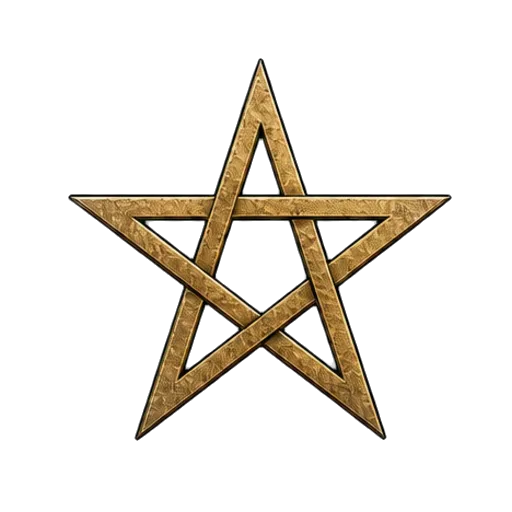
What is a pentagram?
A pentagram is the star itself: five straight strokes forming five outer points and a smaller pentagon at the center. A regular pentagram can be drawn in one continuous movement, which is why it is sometimes called an interlaced or unbroken star.
The figure has a distinctive mathematical structure. Its intersecting segments repeat the golden ratio, and smaller pentagons and pentagrams can be found within the same construction. This geometry helps explain why later writers connected it with proportion, order, and harmony. The mathematics is observable; spiritual conclusions drawn from it belong to particular philosophical or religious interpretations.
A pentagram is also not automatically a pentacle. In common contemporary Pagan usage, a pentacle usually means a pentagram enclosed by a circle or displayed on a disk. Historical terminology is more complicated. Read the full guide to the difference between a pentagram and a pentacle.
How old is the pentagram?
Five-pointed star signs are documented in ancient Mesopotamian writing. Proto-cuneiform examples from the Jemdet Nasr period show that the form existed thousands of years before modern Wicca, ceremonial occultism, or contemporary popular culture.
That does not mean an ancient sign carried today’s familiar meanings of “the five elements” or “Pagan protection.” Early signs must be read through their own tablets, language, and administrative or religious setting. Similar-looking shapes can acquire very different meanings in different societies.
This is the first important rule of symbol history: the age of a shape is not proof that one modern interpretation is equally ancient.
The Pythagoreans: health, recognition, and harmony
The pentagram became closely associated with the Pythagorean tradition of the ancient Greek world. Historical and medical-symbol scholarship describes it as an emblem of health and a sign by which Pythagoreans could recognize one another. The association is often linked with the Greek word hygieia, meaning health.
Its ordered geometry suited a philosophical community interested in number, proportion, music, and the structure of the cosmos. This is one of the strongest historical foundations for later interpretations of the pentagram as harmony. Even here, however, “harmony” should be understood within a specific philosophical tradition rather than as a timeless definition shared by every culture.
Medieval and early modern meanings
In medieval Europe, fivefold symbols could appear within Christian, protective, literary, and magical settings. One well-known literary example is the pentangle on Sir Gawain’s shield in the fourteenth-century poem Sir Gawain and the Green Knight, where the endless knot expresses a network of fivefold virtues. This is a Christian chivalric use, not a modern Pagan one.
Early modern ritual-magic manuscripts also used complex seals, stars, divine names, and geometric diagrams. The word pentacle in these sources often meant a consecrated talisman or diagram and did not always mean “a pentagram inside a circle.” This broader historical vocabulary is why modern readers should check how each source defines its terms.
The nineteenth-century occult revival
Modern ideas about the pentagram were strongly shaped by nineteenth-century Western occult writers. Éliphas Lévi’s Dogme et Rituel de la Haute Magie gave influential interpretations to the star, the human microcosm, the elements, and its orientation. Lévi treated an upright and inverted pentagram differently and helped popularize a moral contrast that later occultists and popular media repeated.
This history is important because it shows that the familiar “upright is good, inverted is evil” formula is not an eternal law encoded in the geometry. It is an influential interpretation developed and transmitted within particular modern esoteric systems.
What do the five points represent?
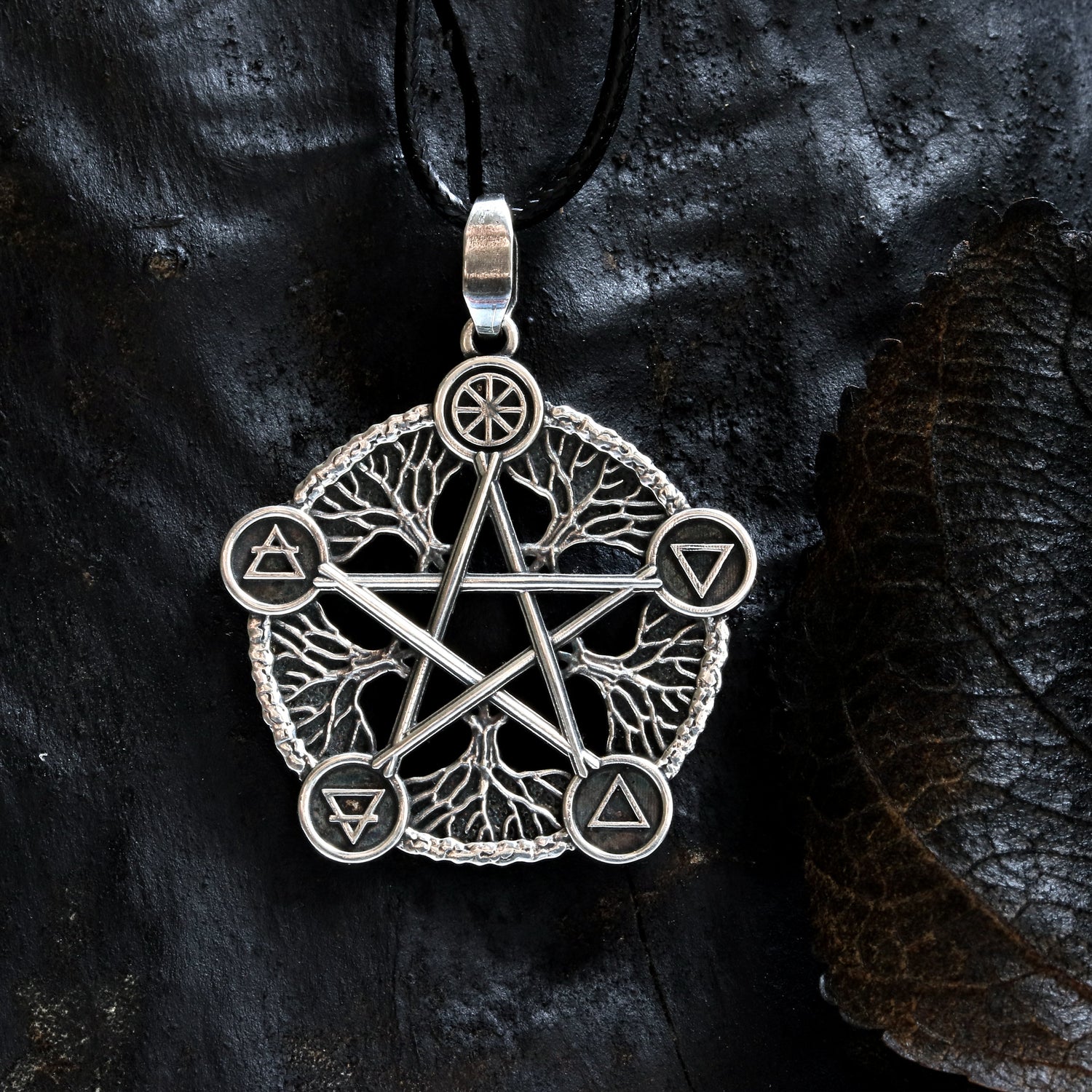
In many contemporary Pagan, Wiccan, witchcraft, and Western esoteric frameworks, the points represent:
- Earth - body, stability, material life, growth;
- Air - thought, communication, breath, movement;
- Fire - will, transformation, energy, courage;
- Water - emotion, intuition, healing, flow;
- Spirit - connection, consciousness, or the principle uniting the other four.
Different traditions arrange and describe these correspondences differently. The five-element model is a meaningful modern spiritual map, not a translation key for every pentagram ever made. For a deeper explanation, continue with our guide to spirit, air, fire, water, and earth.
Pentagram meaning in modern Paganism and Wicca
Today, many Pagans and Wiccans use the pentagram or pentacle as an expression of spiritual identity and relationship with nature. The five points may show the elements acting as a balanced whole. The unbroken line may suggest interconnection, while a surrounding circle may add meanings such as unity, sacred space, protection, continuity, or the cycles of nature.
There is no central Pagan authority that imposes one definition. A solitary practitioner, a Wiccan tradition, a ceremonial magician, and a reconstructionist Pagan may understand or use the image differently. Some wear it daily; others reserve it for an altar, ritual tool, or specific practice.
Upright and inverted pentagrams
An upright pentagram has one point at the top. Many modern diagrams place spirit at that upper point and read the form as spirit relating to or guiding the four material elements.
An inverted pentagram has two points at the top. Some occult systems interpret this as matter placed above spirit. Specific modern Satanic traditions also use particular inverted pentagram designs as their own religious emblems. But orientation alone does not reveal a wearer’s ethics, intent, or complete belief system. Other groups and individuals may use an inverted form for initiation, descent, embodiment, personal symbolism, art, or no religious purpose at all.
Context is therefore more accurate than a simple good-versus-evil rule.
Is the pentagram evil?
No-the shape itself is not inherently evil. Its documented history includes health, proportion, Christian virtue, ritual protection, modern Pagan identity, occult philosophy, mathematics, art, and many other uses. Horror films and sensational imagery selected only a narrow part of that history and made it appear universal.
To interpret a pentagram responsibly, ask:
- What exact design is shown-plain star, circled pentacle, inverted star, or a symbol with additional marks?
- When and where was it made?
- Who used it, and what did that person or community say it meant?
The symbol cannot answer those questions without its context.
Is the pentagram a protection symbol?
It can be. Protective meanings are well established in several magical, esoteric, Pagan, and folk-influenced practices. Practitioners may trace or display the star to mark balance, invoke elemental relationships, define a boundary, or express a protective intention. A circled pentacle often emphasizes containment, unity, or sacred space.
Protection is still a meaning given through a tradition and practice-not a scientifically measurable property of the geometric figure. This distinction allows spiritual interpretation to be presented respectfully without turning belief into a historical or scientific claim.
What does wearing a pentagram mean?
Wearing a pentagram may communicate Pagan or Wiccan identity, elemental balance, protection, devotion, connection with nature, interest in occult history, or appreciation of the geometry. It does not automatically identify someone with one religion or practice.
Before choosing jewelry, look at the complete design. A circle, moon, tree, deity image, rune, animal, gemstone, or orientation can add another layer of meaning. Choose a symbol whose significance you understand and can describe in your own words.
Once you know which form fits your intention, explore our pentagram and pentacle collection. The historical and spiritual meaning should guide the choice; the product does not define the tradition.
Sources and further reading
- “The Pythagoreans’ Emblem of Health” in The Pentagram as a Medical Symbol - scholarly history of the Pythagorean association.
- “The Five-Pointed Star as a Symbol of Health” - a historical review containing early Mesopotamian and Pythagorean examples.
- Éliphas Lévi, “Le Pentagramme Flamboyant” - a primary source for an influential nineteenth-century occult interpretation.
- The Key of Solomon - an example of the historically broader use of the term “pentacle.”
Last reviewed: July 19, 2026. Historical claims and modern spiritual interpretations are identified separately where their contexts differ.
Continue the learning path
Explore supporting guides

From the workshop


1 comment
Charles kingston
Revels
Revels