
Reviewed and updated Aug 14, 2026
Obsidian is volcanic fire made still. Born when lava cools too quickly to form large crystals, it carries a dark reflective surface and an edge sharp enough to become both ancient tool and ritual mirror. In contemporary witchcraft it is one of the best-loved stones for protection, grounding, boundaries, shadow work, and the courage to look honestly at what is reflected back.
Because obsidian comes directly from volcanic activity, it is often connected symbolically with Earth and Fire. For the wider framework, see our pillar guide to the five elements in Paganism.
What is obsidian?
Obsidian is a dense volcanic glass, commonly rhyolitic in composition and rich in silica. When highly viscous lava cools quickly, its atoms do not have enough time to organize into the large crystal structure found in many other rocks. The result is a glassy material that may be black, brown, gray, reddish, greenish, banded, or translucent at thin edges.
Although shops and spiritual communities often place obsidian in the broad category of “crystals,” it is not a crystal in the strict geological sense. It is an amorphous volcanic glass. That distinction does not make it less interesting; it explains its smooth appearance, its curved fracture surfaces, and many of its practical uses.
Why is obsidian so sharp?
Obsidian breaks with a conchoidal fracture: a smooth, curved break that can produce an extremely fine edge. People learned to shape it into cutting tools and projectile points in many volcanic regions. At Yellowstone’s Obsidian Cliff, for example, archaeological evidence shows quarrying for toolmaking more than 11,000 years ago, and material from that source traveled through extensive exchange networks across North America.
This physical property also creates a safety concern. A polished cabochon is very different from a broken flake. Chipped obsidian can be razor-sharp, so damaged jewelry or rough specimens should not be handled along fractured edges.

Obsidian in history and material culture
Obsidian has carried many lives. Communities close to volcanic sources shaped it into blades, exchanged it across long routes, wore it as ornament, and polished it into dark reflective surfaces. Museum collections preserve mirrors from pre-16th-century Mesoamerica and Ecuador, as well as Mexica sculpture and ritual objects whose gleaming black surfaces joined material skill with sacred imagination.
Each of these traditions gives obsidian its own language. A quarry, a mirror, a blade, and a devotional object may all hold different relationships with place and spirit. Contemporary crystal practice adds another chapter to that longer story while living Indigenous relationships with particular landscapes retain their own depth and authority.
What does obsidian symbolize today?
In many contemporary Pagan, witchcraft, and crystal practices, black obsidian is associated with:
- Protection and boundaries: used as a reminder to recognize limits and choose what receives attention.
- Grounding: connected symbolically with steadiness, the body, Earth, and practical action.
- Reflection: its polished dark surface may serve as a metaphor for looking honestly at thoughts or patterns.
- Release and transformation: its volcanic origin can represent change, cooling, and the formation of something new after disruption.
These meanings become active through relationship: the form of the stone, the intention given to it, the place it occupies, and the actions repeated around it. One practitioner may experience obsidian as a boundary stone, another as a mirror for truth, and another as a companion for divination.
Is obsidian a protection stone?
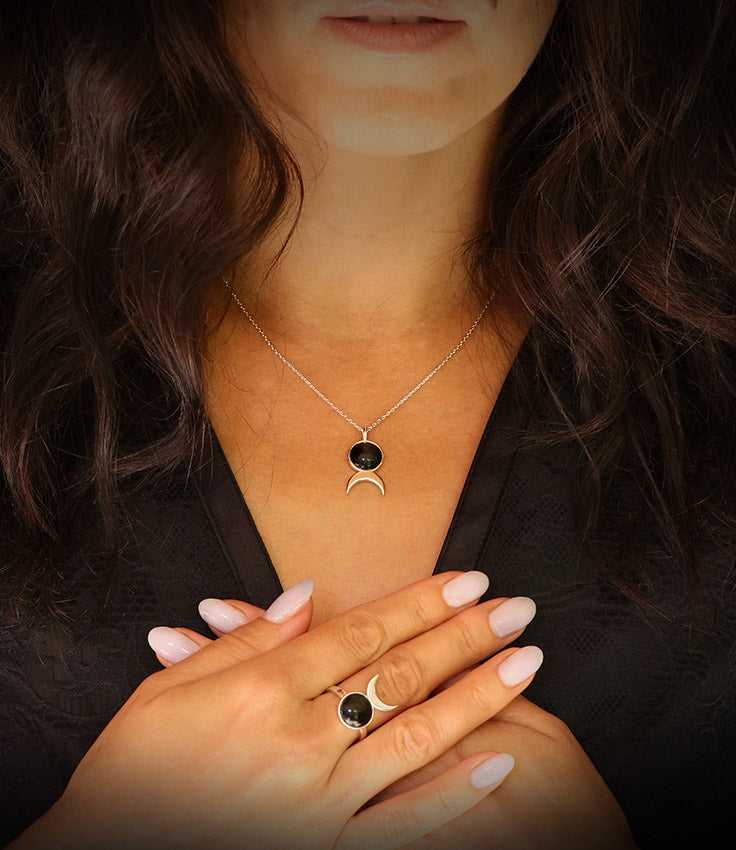
Obsidian is widely described as a protection stone in modern metaphysical practice. A person might wear it, place a polished piece near an entryway, or use it during meditation as a physical reminder of boundaries and intentional choices.
In protective work, obsidian is often placed at an entrance, worn close to the body, or held while a boundary is spoken aloud. The stone becomes a dark threshold: what belongs may enter; what drains, confuses, or intrudes is turned away. Pair the ritual with practical care-locks, clear communication, safety planning, and trusted support-so spiritual and everyday protection reinforce one another.
An obsidian mirror for scrying
Polished obsidian has a long relationship with reflection, and black mirrors remain a familiar tool in contemporary witchcraft. Sit where the surface catches only dim indirect light, soften your gaze, and allow shapes, memories, or impressions to rise without forcing them. Record what appears before interpreting it. Practitioners on Reddit repeatedly describe obsidian mirrors as tools for both scrying and protective presence, especially near an altar or doorway.
Obsidian for shadow work and emotional truth
Obsidian’s reflective darkness makes it a natural companion for shadow work: naming a fear, tracing the origin of a repeated pattern, or noticing the truth hidden beneath anger or avoidance. Hold the stone, ask one precise question, and write without censoring the first answer. The purpose is not to punish yourself with “hard truths,” but to see clearly enough to choose differently.
Work gently. If reflection becomes overwhelming, close the ritual, return attention to the room and body, and seek appropriate support. Spiritual practice can accompany healing, while trauma, anxiety, depression, and pain still deserve qualified care.
Black, snowflake, mahogany, and rainbow obsidian
| Common name | Physical appearance | Common modern symbolism |
|---|---|---|
| Black obsidian | Dark volcanic glass, sometimes translucent at thin edges | Boundaries, grounding, protection, reflection |
| Snowflake obsidian | Gray or white radiating patches of cristobalite created as the glass devitrifies | Balance, patterns, patience |
| Mahogany obsidian | Black glass with reddish-brown areas or bands | Stability, vitality, connection with Earth |
| Silver, gold, rainbow, or fire obsidian | Sheen or iridescence produced by internal layers and aligned inclusions | Insight, hidden qualities, transformation |
Each variety keeps the volcanic character of obsidian while offering a different visual doorway. Let color, sheen, pattern, and the response you feel in the hand help determine which one belongs in the work.
How to use obsidian in a spiritual practice
- Choose one intention. Instead of expecting the stone to solve a problem, decide what it will remind you to do: maintain a boundary, reflect before acting, or return to a practical task.
- Use a safe finished object. Select polished jewelry, a securely mounted piece, or a stable object without chips or exposed cutting edges.
- Connect symbol with action. If obsidian represents protection, pair it with a real safety measure. If it represents grounding, pair it with rest, food, movement, planning, or contact with a trusted person.
- Journal without forcing an answer. Ask what needs honest attention, what boundary is missing, and what action is possible today.
- Review the practice. Keep what supports you and stop any exercise that increases fear, obsession, or distress.
To awaken the relationship, cleanse the finished object in a way safe for its setting, hold it between both hands, name its purpose, and place it where that purpose can be repeated. A necklace may mark a boundary each time it is fastened; a mirror may open a scrying session; an altar stone may receive the worries you are ready to lay down.
Obsidian safety and care
- Inspect jewelry and specimens for cracks, chips, sharp points, and loose settings.
- Do not strike, deliberately break, or pressure-test obsidian. Keep broken pieces away from children and pets.
- Store polished pieces separately from harder jewelry to reduce scratching and chipping.
- Follow the maker’s instructions for assembled jewelry. A soft cloth is the safest routine option; where appropriate, use mild soap and lukewarm water, then dry thoroughly.
- Avoid sudden temperature changes, harsh chemicals, abrasive cleaners, and ultrasonic cleaning unless a qualified jeweler confirms that the complete piece is suitable.
- Do not collect obsidian from archaeological sites, protected land, or culturally significant places. Follow local law and site rules.
What to look for when choosing obsidian jewelry
Choose an object whose workmanship supports the ritual you imagine. Look for a smooth polish, protected edges, a secure setting, an accurate material description, and care instructions that cover the metal and any additional stones as well as the obsidian.
Color bands, snowflake-like patches, translucency, and silver or rainbow sheen arise from the stone’s formation and inclusions. In ritual, those visible differences can become part of its voice: snowflake patterns for balance, mahogany tones for embodied strength, and shifting sheen for what is waiting beneath the surface.
Sources and further reading
- U.S. Geological Survey: Yellowstone’s tool-making lava flows - formation, composition, fracture, and tool use.
- National Park Service: Obsidian Cliff - quarrying, archaeological evidence, and long-distance movement of the material.
- Smithsonian: Snowflake Obsidian - cristobalite inclusions and devitrification.
- Gemological Institute of America: Sheen and iridescent obsidian - internal structures behind optical effects.
- The Metropolitan Museum of Art: Obsidian mirror from Mexico - a documented pre-16th-century object.
- Scott Cunningham, Encyclopedia of Crystal, Gem & Metal Magic - a widely used modern witchcraft reference for stone correspondences.
- r/witchcraft: Obsidian and how practitioners use it - protection, scrying, mirrors, and household practice.
Last reviewed: August 13, 2026. This guide follows obsidian from volcanic material and ancient mirror into contemporary protective, reflective, and divinatory practice.
From the workshop