

Reviewed and updated Jul 27, 2026
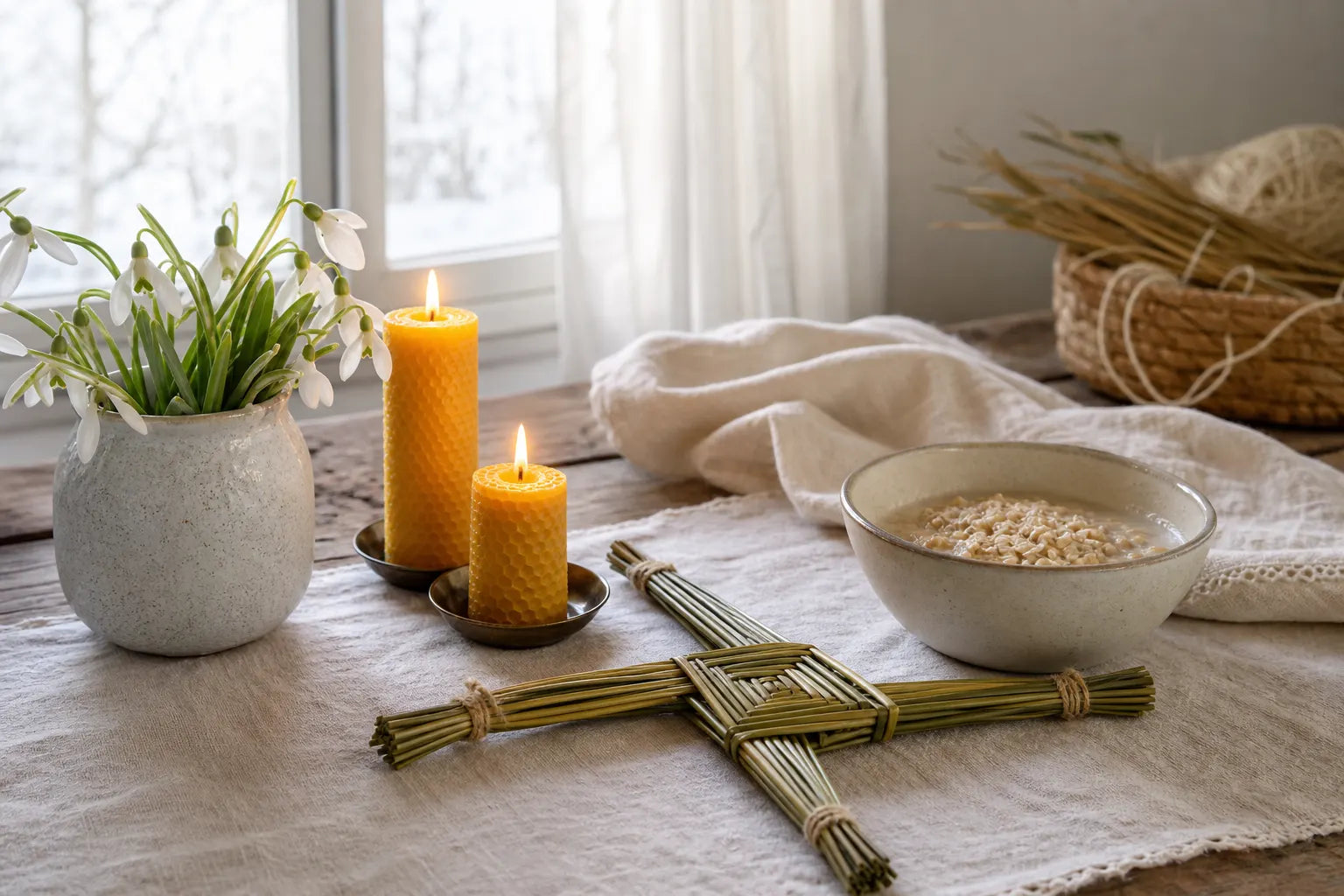
An Imbolc altar often uses candles, a Brigid’s cross, a simple white cloth, water, seasonal food and signs of early spring. No single altar setup is historically required. Candles express returning light in modern practice, while documented Irish Brigid’s Day traditions place greater emphasis on protection, hospitality, household blessing, woven crosses, the brat Bríde and the beginning of spring.
This guide separates historical custom from modern correspondence lists. For the wider context, read our complete Imbolc pillar guide or explore the Wheel of the Year.
Imbolc altar correspondences at a glance
| Element | Meaning | Evidence note |
|---|---|---|
| Candle or lamp | Returning light, attention and renewal | Prominent in modern Pagan Imbolc and Candlemas-influenced practice |
| Brigid’s cross | Protection and blessing of the home | Well documented in Irish St Brigid’s Day tradition |
| White cloth or brat Bríde | Blessing, healing and household protection | Documented regional folk custom; forms vary |
| Water | Wells, cleansing and blessing | Connected with Brigid’s holy wells and modern ritual |
| Milk, oats or bread | Hospitality, livestock and seasonal sustenance | Useful modern altar foods; avoid claiming one universal ancient offering |
| Early flowers | Local signs of spring | Modern seasonal symbol; use local ecology responsibly |
What candles are used for Imbolc?
White, ivory, yellow and beeswax candles are common because they suggest light and the early return of the Sun. Green may represent new growth, and red is sometimes used for Brigid’s fire. These are modern correspondences, not universal rules inherited unchanged from ancient Ireland.
The best candle is one you can use safely. A single candle is enough. If open flame is unsuitable, use an electric candle, lamp or reflective bowl. Meaning comes from attention and action, not from the number or color of candles purchased.
A simple Imbolc candle practice
- Place one candle on a stable, fireproof surface.
- Name one area of life where clarity is returning.
- Choose one practical task that supports that renewal.
- Sit with the light briefly, then extinguish it fully.
How to create a simple Imbolc altar
Start with a small surface rather than filling the space. A grounded arrangement might include:
- a plain cloth in white, cream or natural linen;
- one or two safe candles;
- a Brigid’s cross woven from rushes, straw or paper;
- a bowl of water or image of a local well;
- a small portion of oats, bread or milk that will be consumed rather than wasted;
- one natural sign of the actual season where you live.
If you honor Brigid as a saint, goddess or both, be clear about your religious context. Historical sources and living Irish traditions do not collapse these identities into one simple formula.
What are the colors of Imbolc?
Common modern Imbolc colors include:
- white and cream for snow, milk, clarity and simplicity;
- yellow and gold for candlelight and the strengthening Sun;
- green for the first visible growth;
- red for fire, vitality and some modern associations with Brigid.
Use color as a design language, not historical proof. Local winter may be brown, wet, gray, flowering or intensely green. Let observation correct the standardized palette.
Brigid’s cross and household protection
Brigid’s crosses were traditionally woven around St Brigid’s Day and placed in the home for protection and blessing. Designs and materials vary by region. If rushes are unavailable, paper strips provide an accessible, non-invasive alternative.
The cross should not be treated as a generic decorative “Celtic symbol” detached from Irish tradition. Learn the pattern, acknowledge its context and decide respectfully whether it belongs in your practice.
What is the brat Bríde?
The brat Bríde, or Brigid’s cloth, was left outside on the eve of the feast in the hope that Brigid would bless it. It could later be kept for healing or protection. Accounts vary: the cloth might be a ribbon, garment or piece of fabric.
A contemporary adaptation can use a small natural-fiber cloth placed in a sheltered location, provided it will not become litter or endanger wildlife. Bring it inside the next morning and use it as a reminder to offer real care where it is needed.
Imbolc offerings and seasonal food
Milk, butter, oats, bread and water are frequently associated with Imbolc or Brigid in modern practice. Avoid leaving food outdoors where it can harm animals or introduce waste. Eat it, share it, compost it appropriately, or donate food to a community organization.
An offering can also be an action: repair a household item, support maternal health, assist an animal shelter, clean a shared space or learn a useful craft.
A complete ten-minute Imbolc observance
- Clean one small surface and place a cloth upon it.
- Add a candle, a bowl of water and a Brigid’s cross or seasonal object.
- Observe what the local season is actually doing.
- Light the candle and name what you are preparing to renew.
- Choose one concrete action for the next week.
- Share or consume any food and extinguish the flame safely.
Imbolc in the Southern Hemisphere
Many Southern Hemisphere practitioners shift Imbolc to around August 1 so that it corresponds with the beginning of spring. Others keep February 1 because of ancestry, church calendar or community tradition. State which calendar you follow and let local ecology shape your symbolism.
Continue exploring Imbolc
- Brigid’s Cross: meaning, history and weaving tradition
- Candlemas, light and purification
- Imbolc, fertility and rebirth
Sources and further reading
- National Museum of Ireland - St Brigid’s Day traditions and folk customs
- National Museum of Ireland - Irish quarter days
- dúchas.ie - The Schools’ Collection: St Brigid’s Day
Last reviewed: July 27, 2026. Living tradition, historical folk custom and contemporary Pagan correspondence are identified separately.