
Pagan protection symbols do not form one universal alphabet. A pentacle, Hecate's key, Thor's hammer, a rune, or a household charm belongs to a particular historical and cultural setting. Responsible use begins with learning that setting, not with promising guaranteed supernatural protection.
At a glance
- Protection may mean boundary, guardianship, courage, remembrance, or ritual care.
- A symbol can support intention but does not replace medical, legal, or physical safety.
- Ancient evidence, later folklore, and modern practice should be labelled separately.

What does protection mean in Pagan practice?
Protection may describe marking a sacred boundary, asking a deity for guardianship, carrying a reminder of courage, maintaining household order, or using a familiar object during prayer. Some traditions emphasize apotropaic actions intended to turn away harm. Others emphasize blessing or purification.
Symbols can remind us to act, but they do not replace locks, medical care, documentation, emergency plans, or trusted people.
The pentacle
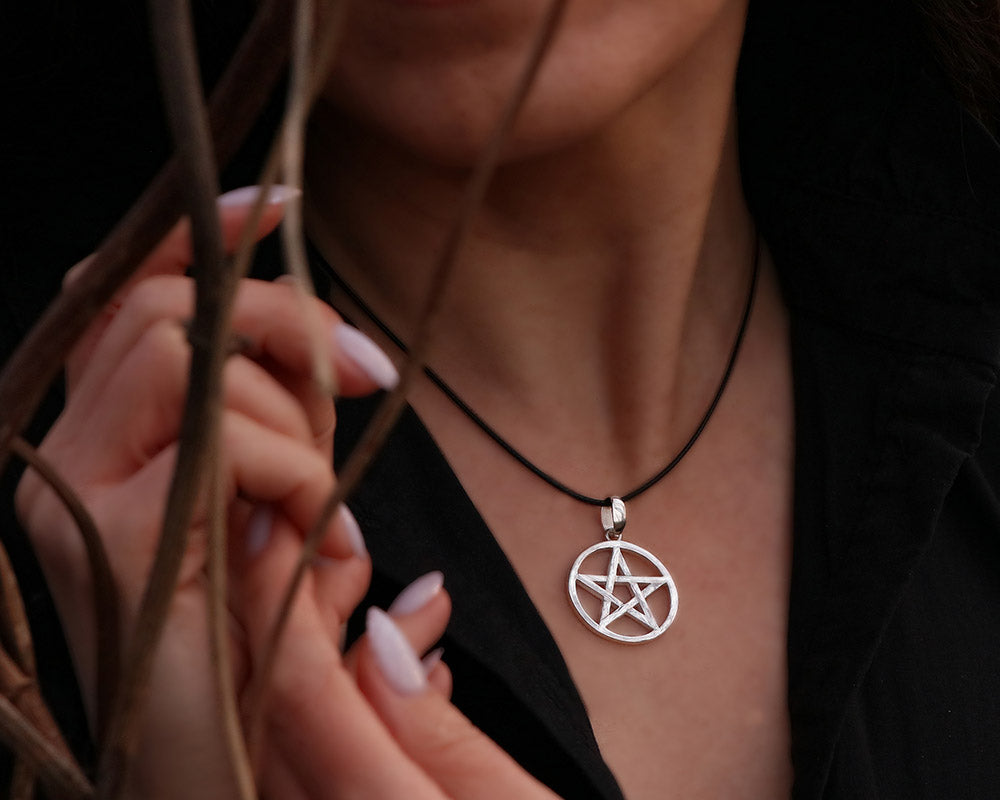
In modern Pagan and Wiccan contexts, the pentacle commonly means a five-pointed star within a circle. The points are often linked with earth, air, fire, water, and spirit; the circle may express unity, wholeness, sacred space, or protection. Older ritual-magic sources used pentacle more broadly for consecrated disks and diagrams. Read the full pentacle guide for that distinction.
Hecate's keys, torches, and thresholds
Hecate's associations with entrances, crossroads, torches, dogs, and later keys make her imagery relevant to boundaries and guardianship. A key may symbolize control over access; a torch can represent enough light to move carefully; a crossroads can mark the responsibility of choosing.
Norse symbols and later magical staves
Mjollnir, Thor's hammer, is well attested in Viking Age pendants and could express blessing, protection, or community identity. By contrast, the popular Icelandic Aegishjalmur and Vegvisir are known from much later manuscripts. They remain meaningful, but should not be advertised as securely documented Viking Age designs.
Runes are letters in historical alphabets. Individual runes acquired poetic and magical associations, yet a modern chart assigning each rune one fixed protective power is not identical to the historical evidence.
Amulets and household objects
Across cultures, people carried inscribed objects, beads, divine images, knots, eyes, hands, stones, and written prayers. The term amulet is useful as a broad category, but it should not erase an object's original name or culture. Jewelry keeps a sign close to the body; a household object may instead mark a doorway, altar, or family space.
How to choose responsibly
- Name the tradition instead of mixing cultures without context.
- Check whether the evidence is ancient, medieval, early modern, or contemporary.
- Read the complete design, including letters, animals, and added circles.
- Choose a clear function such as boundary, courage, devotion, or focus.
- Pair symbol with practical protective action.
Frequently asked questions
What is the strongest Pagan protection symbol?
There is no objective ranking. The best choice is historically understood, appropriate to your path, and connected to responsible action.
Can I combine symbols?
Yes, but label the combination as modern and avoid claiming an unsupported ancient connection.
Continue exploring
Sources and further reading
- British Museum Collection
- Metropolitan Museum - Heilbrunn Timeline
- World History Encyclopedia - Thor's Hammer
Last reviewed: October 2026. Historical evidence and modern spiritual interpretation are identified separately where they differ.