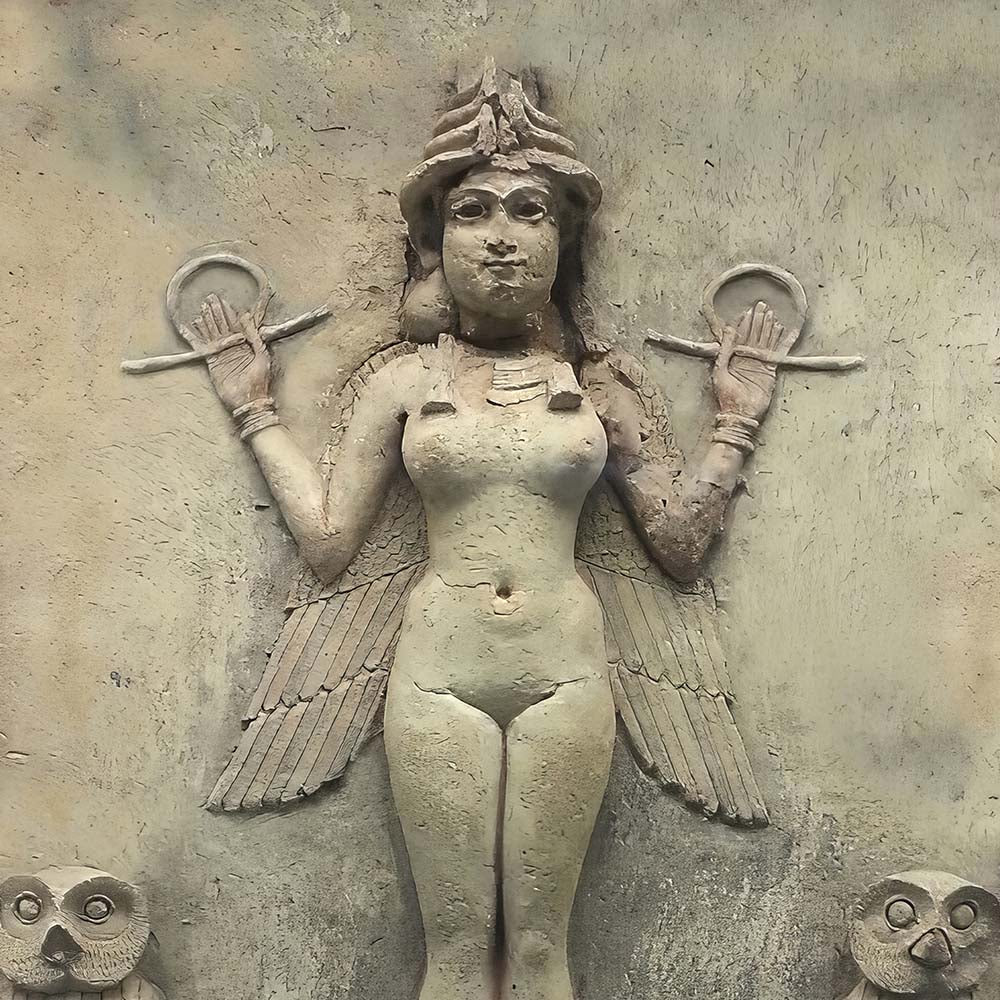
What did worship of Ishtar actually look like? The answer changes across Sumerian, Babylonian and Assyrian cities and across more than two thousand years. Inanna/Ishtar received temple service, food and drink offerings, hymns, royal patronage and private prayer. No single surviving text provides a timeless ritual manual, so this guide separates documented ancient practice from responsible modern devotion.
At a glance
- Inanna is the Sumerian name; Ishtar is the Akkadian name most widely used in Babylonian and Assyrian sources.
- Uruk and its Eanna precinct form the best-known early center, but the goddess had important temples across Mesopotamia.
- Offerings belonged to organized temple economies as well as personal prayer.
- The eight-pointed star and Venus are central identifiers; the lion and rosette are also important.
Temples and cult centers
Inanna/Ishtar was among the most important Mesopotamian deities. Her principal city was Uruk, where Eanna - the “House of Heaven” - was associated with her and Anu. Other major forms included Ishtar of Nineveh and Ishtar of Arbela. Local forms could possess their own titles, festivals and political meanings rather than functioning as identical copies of one centralized cult.
Temples were institutions with land, staff, storage and scheduled offerings. Worship was not limited to private belief: it participated in the economic and civic life of a city.
Offerings and daily service
Cuneiform records describe regular presentations of bread, dates, beer, animals, oils and incense to Mesopotamian deities. A “lifted-hand” prayer ritual for Ishtar preserves purification, a portable altar, dates, fine flour, cake, honey, ghee and beer. This is evidence for a particular learned ritual context - not permission to claim that every worshipper everywhere used the same list.
Royal gifts could include precious vessels, garments and restoration of temples. Private devotion also appears in prayers and personal names. The scale changed, but reciprocity, praise and care for divine presence remained important.
Hymns, prayers, and festivals
Hymns address the goddess as morning and evening star, lover, warrior and power behind kingship. Texts attributed to or associated with Enheduanna give Inanna a voice of terrifying authority and intimate devotion. Later Akkadian prayers ask Ishtar for mercy, protection and restored favor.
Modern readers should resist merging every surviving poem into one biography. The texts came from different cities, languages and centuries.
Modern devotion without false reconstruction
A historically honest modern practice may begin with study, a clean space, a spoken hymn, fresh water, bread or dates, and attention to Venus - provided the practitioner clearly calls this a modern devotional choice. Avoid presenting an invented “ancient Ishtar ritual” as recovered fact.
When adapting offerings, consider safety, local laws and respectful disposal. Devotion is not measured by expense.
A symbol carried in metal
The eight-pointed star is one of the clearest ways to identify Ishtar’s astral aspect. Jewelry can function as a reminder of a relationship or study practice, but it does not replace learning about the culture from which the symbol comes.
Continue exploring
- Ishtar and Inanna: history, myths, and worship
- Symbols of Ishtar
- Stones associated with Ishtar and Inanna
Frequently asked questions
What offerings were given to Ishtar?
Texts attest foods, beer, incense, oil, garments, animals and precious gifts in different temple and ritual contexts.
Can a modern Pagan worship Ishtar?
Yes, many do. The clearest approach distinguishes modern devotion from claims about exact ancient continuity.
Was Ishtar worship only about sexuality?
No. She was also a major goddess of warfare, astral power, kingship and political authority.
Sources and further reading
- ORACC: Inana/Ishtar
- ORACC text: a lifted-hand prayer ritual to Ishtar
- Electronic Text Corpus of Sumerian Literature: The Exaltation of Inana
Last reviewed: October 2026. Ancient evidence and modern devotional practice are identified separately where they differ.