
The Morrígan is a formidable figure in medieval Irish literature associated with battle, prophecy, sovereignty, cattle, land, transformation, and the consequences of heroic action. She cannot be reduced to a generic “war goddess,” and her relationship with Badb, Macha, and Nemain changes from text to text.
Explore this figure in the interactive Gods & Goddesses Atlas.
At a glance
- Culture: medieval Irish literary tradition with roots in pre-Christian religious material
- Name interpretations include “Great Queen” and “Phantom Queen”; the linguistic question is debated.
- Roles: battle prediction, sovereignty, cattle, territorial power, fate, transformation, and the testing of heroes.
- Important narratives include the Táin Bó Cúailnge and the Second Battle of Mag Tuired.
- She may appear alone, overlap with Badb, or belong to variable groupings of female figures.
Name, sources, and necessary uncertainty
The name appears in several spellings and grammatical forms. Translating it as “Great Queen” or “Phantom Queen” depends on how scholars understand its components. A responsible introduction presents the debate instead of turning one translation into settled fact.
Most detailed evidence comes from medieval manuscripts produced in Christian Ireland. The stories may preserve older religious concepts, but their written forms belong to particular authors, audiences, and centuries. Archaeology cannot simply supply a portrait of the Morrígan where texts are silent.
The Táin and Cú Chulainn
In the Táin Bó Cúailnge, the Morrígan encounters Cú Chulainn, offers aid or relationship, and after rejection opposes him in animal forms commonly described as eel, wolf, and cow. Later she appears as an old woman milking a cow; he blesses her wounds without recognizing her, fulfilling a condition for healing.
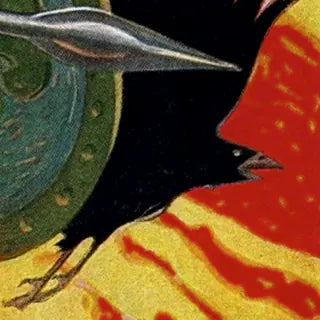
Near the hero’s death, a crow or raven settles on him, signalling to his enemies that he has died. The sequence links prophecy, transformation, cattle, conflict, and the limits of heroic perception.
The Dagda and the Second Battle of Mag Tuired
Before battle, the Morrígan meets the Dagda at a river and promises aid against the Fomoire. After victory she proclaims the outcome and delivers a prophecy that moves from abundance toward social disorder.
The episode is sometimes described only as a sexual union of sovereignty and king. That framework can illuminate it, but the text also presents strategy, territorial power, speech, and the frightening knowledge of what follows victory.
Badb, Macha, Nemain, and the “triple goddess” question
Some texts use Morrígan and Badb almost interchangeably; others list them separately. Macha and Nemain enter different groupings, genealogies, and battle scenes. There is no single canonical list that consistently defines three fixed members.
The modern Maiden-Mother-Crone model does not describe these figures in the medieval Irish sources. Calling the Morrígan “triple” can refer to textual plurality or modern theology, but those meanings should not be confused.
Battle, sovereignty, cattle, and land
Battle in Irish heroic literature is never merely combat technique. It concerns cattle wealth, boundaries, honor, kingship, kinship, and the land’s response to rightful or broken rule. The Morrígan’s prophecies reveal consequence rather than offering simple victory magic.
Washer-at-the-ford traditions, where a female figure washes bloody garments before death, are related to later Irish and Scottish folklore. They illuminate a wider cultural image but should not automatically be used as proof for every early Morrígan episode.
Symbols and evidence
Crows and ravens, cattle, the river or ford, wolf and eel forms, blood-red imagery, and the battlefield are grounded in particular narratives. Modern symbols such as a fixed triskelion, a universal black-and-red color code, or a specific crystal system may be meaningful personal correspondences but are not directly established by medieval sources.
Modern Pagan reception
Modern devotees often approach the Morrígan through courage, boundaries, sovereignty, truth-telling, political responsibility, grief, and remembrance of war’s cost. Serious study of the Irish texts is itself a form of respect.
Avoid using the Morrígan to glamorize violence or claiming certainty where manuscripts disagree. Irish names, stories, and landscapes belong to living cultures; attribution and humility matter.
Continue exploring
- Celtic gods and goddesses: pantheons, sources, and symbols
- Morrígan, Badb, Macha, and Nemain: one goddess or four?
- Brigid: poetry, craft, healing, and living tradition
Frequently asked questions
Is the Morrígan a triple goddess?
Some texts group or overlap her with other female figures, but no fixed Maiden-Mother-Crone triad appears in the medieval evidence.
Are the Morrígan and Badb the same?
Sometimes their names and functions overlap; elsewhere they are distinguished. The answer depends on the source.
What bird is associated with the Morrígan?
Crow and raven imagery is strongly associated with battle and with Cú Chulainn’s death, though not every corvid is a personal sign.
Is the Morrígan only a war goddess?
No. Her narratives also concern prophecy, sovereignty, cattle, territory, transformation, fate, and the consequences of heroic action.
Sources and further reading
Last reviewed: August 1, 2026. Ancient evidence, later reception, and modern practice are labelled separately.