Reviewed and updated Jul 19, 2026
Yes. Hecate is securely associated with crossroads, doorways, gates, and other boundaries in ancient Greek religion. Images called hekataia could stand where roads met or near entrances, and ritual material connected with household purification and Hecate's meals was deposited at crossroads.
The modern idea of Hecate guiding every personal life decision grows naturally from this history, but it is an interpretation rather than a complete description of ancient practice. Ancient crossroads were religiously charged boundaries: places of passage, protection, uncertainty, disposal, contact, and potential danger.
Is Hecate the goddess of the crossroads?
“Goddess of the crossroads” is one of Hecate's most historically grounded titles in modern summaries. Ancient evidence connects her not only with road junctions but with a wider family of passage spaces: household doors, city gates, roads, borders, and entrances to sacred areas.
These locations help explain her roles as guardian, guide, and mediator. A threshold separates inside from outside; a gate controls access; a crossroads joins several routes while forcing movement in one direction or another. Hecate belongs at the point where categories meet and passage must be negotiated.
Why were crossroads important in ancient Greek religion?
Crossroads were ordinary pieces of infrastructure as well as symbolically complicated places. People, goods, news, strangers, animals, and ritual materials passed through them. They connected communities while remaining outside the protected center of a household.
Greek ritual used crossroads for more than asking which road to take. Sources connect them with offerings, the disposal of remains from household purification, and rites concerning dangerous or unsettled forces. Hecate's presence could guard a boundary while also acknowledging what lay beyond it.
The popular language of “choosing your destiny” is therefore a useful modern metaphor, not the only ancient meaning. Crossroads could represent decision, but they also dealt with protection, pollution and purification, movement, outsiders, and the relationship between domestic order and the space beyond it.
What were hekataia?
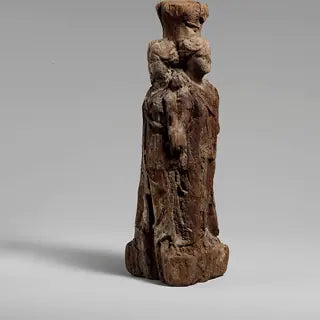
Hekataia were images or shrines of Hecate placed at entrances, roads, and crossroads. In Athens and elsewhere, they could protect a doorway or mark a place where routes converged. People interacted with these images through offerings and everyday religious attention.
Some hekataia show three full figures arranged around a central support so that the goddess faces several directions. Pausanias credits the fifth-century BCE sculptor Alcamenes with an early three-figure image of Hecate in Athens. Other cult images remained single-bodied, so triple form was important but never the only legitimate representation.
A hekataion was not simply a decorative signpost. Its position made the boundary visible and placed it under divine attention. At a household entrance, Hecate could protect the transition between private and public space; at a junction, her image could watch the approaches.
What was Hecate's Deipnon?
Hecate's Deipnon-her “supper” or meal-was associated especially with the close of the lunar month in Athenian practice. Food could be taken to Hecate's shrine or left at a crossroads. Ancient discussions also connect crossroads with the remains of household cleansing rites.
The evidence does not give one universal menu or one ritual manual followed everywhere. Modern lists often include eggs, cakes, garlic, fish, or other foods, but each claim needs its own source and context. It is safer to understand the Deipnon as a recurring relationship among Hecate, the household, purification, offerings, and the boundary outside the home.
Ancient comedy suggests that poor people might take food left for Hecate. That detail complicates claims that no human could ever touch an offering. Practice, belief, literary jokes, and social reality did not always fit one simple rule.
Does Hecate's triple form represent three crossroads?
Triple imagery works naturally at a three-way junction because three figures can face three approaches. This spatial explanation is historically stronger than the claim that the figures originally represented Maiden, Mother, and Crone or waxing, full, and waning moon.
Modern practitioners may use the three forms for past, present, and future or for stages of life. Those systems can be spiritually meaningful when identified as contemporary interpretations. For the full evidence, read Hecate's Three Forms: Ancient Triple Images and Modern Meaning.
How can crossroads symbolism be used today?
A modern practice does not require standing in traffic or leaving objects on public land. A front door, garden path, hallway, driveway, map, three drawn lines, or the meeting point between two routines can serve as a symbolic threshold.
- Clean the entrance to your home as a practical act of caring for a boundary.
- Place a key or drawn crossroads on an indoor altar while considering a decision.
- Write the available paths on paper and identify the cost and responsibility of each.
- Mark the end of a difficult period by safely disposing of the written page at home.
- Donate food or money locally instead of leaving food where it becomes litter or harms wildlife.
If you visit a physical crossroads, remain on a safe pedestrian route, obey traffic laws, respect private property, and take every item home. Do not leave candles, glass, coins, salt, string, food, or sharp objects on roads. A devotional act that endangers people, animals, or workers contradicts the protective intention.
What do crossroads symbolize in modern Hecate devotion?
They can symbolize choice, transition, uncertainty, access, responsibility, and the need to accept that one path excludes another. Hecate may be approached as a witness or guide, but devotion does not remove the practitioner's responsibility to gather information and make the decision.
The crossroads can also represent boundaries that should not be crossed. A key does not open every door, and a guide does not require entry into every unknown space. Discernment includes deciding when to wait, turn back, or ask for practical help.
Frequently asked questions
Is Hecate associated with three-way or four-way crossroads?
Three-way junctions are especially relevant to her triple imagery, but ancient and modern references can use crossroads more broadly. The exact layout is less important than the historical context of roads, entrances, and boundaries.
Do I need to leave an offering at a real crossroads?
No. Use a safe home threshold, altar representation, cleanup, or charitable donation. Modern devotion should respect local law, sanitation, wildlife, and other road users.
Is every crossroads sacred to Hecate?
Ancient evidence shows a strong association, not a rule that every intersection automatically functions as her sanctuary. Sacred meaning depends on religious practice and context.
Does Hecate decide which path I should take?
Some devotees seek guidance through prayer or divination, but interpretations remain personal. Important medical, legal, safety, and financial decisions still require reliable information and qualified advice.
How do keys and torches relate to crossroads?
A torch makes a route visible, while a key controls passage through a boundary. Together with the crossroads, they form a coherent symbolic language of guidance, access, protection, and choice.
For the complete historical overview, return to Hecate: Goddess of Magic, Crossroads, Keys, and the Night.
From the workshop


1 comment
Holly Eberhard
Thrilled to be part of this community!
Thrilled to be part of this community!