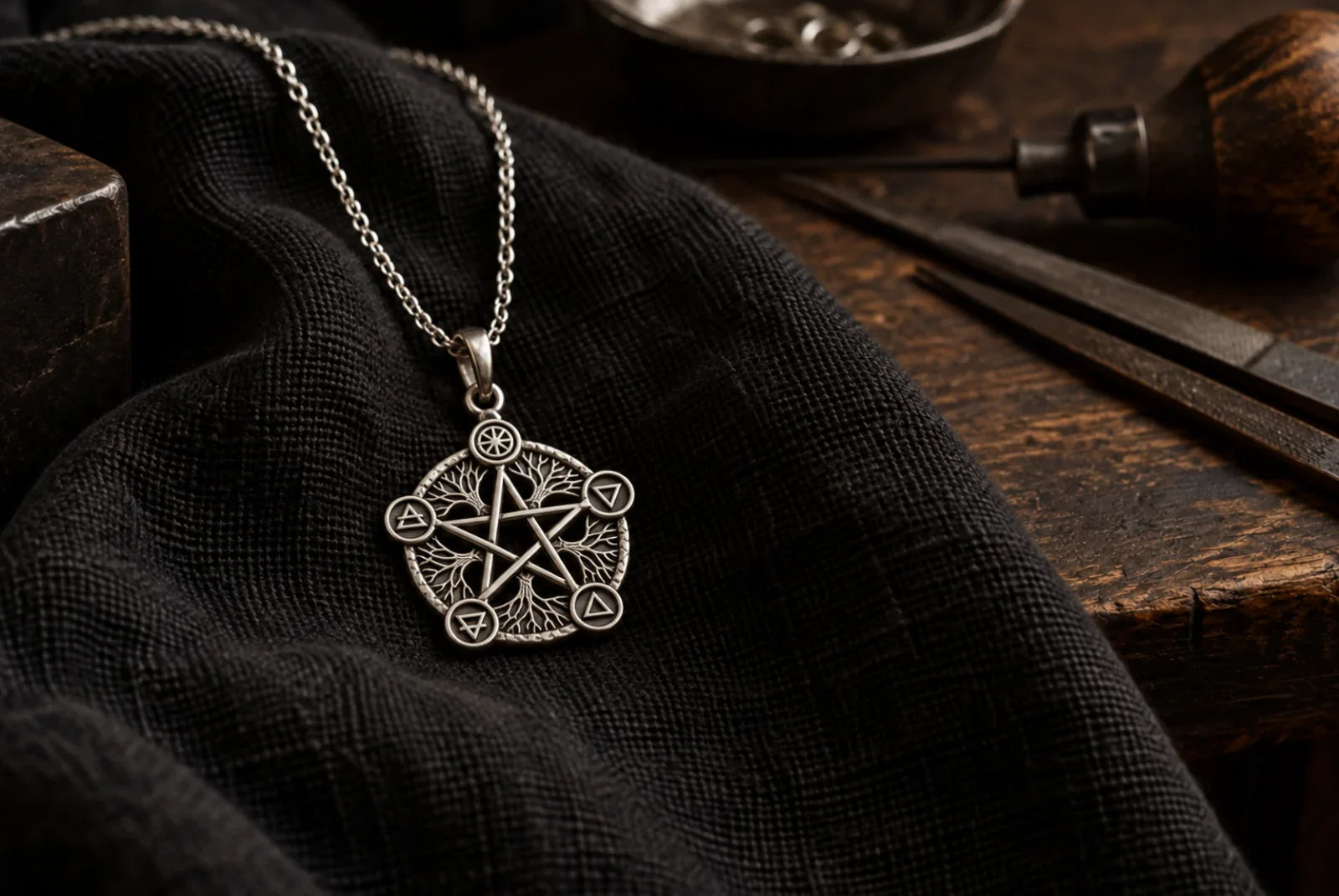
The short answer: an inverted pentagram is a five-pointed star with one point downward. It is not automatically an evil symbol. Its meaning changes with period, tradition, surrounding imagery, and the intention of the person using it.
At a glance
- Orientation alone does not prove harmful intent.
- A plain inverted pentagram is not identical to the Sigil of Baphomet.
- Occult, initiatory, Satanic, artistic, and personal contexts give the form different meanings.
What does an inverted pentagram mean?
Turning the star point-down changes its visual hierarchy, but it does not create one universal meaning. Some modern writers interpret an upright star as spirit above the four material elements and the inverted form as matter above spirit. Others read it as descent, embodiment, initiation, challenge, or deliberate reversal. These are interpretations within particular systems, not a code shared by every culture that used five-pointed stars.
First read our pentacle vs pentagram guide for the basic distinction between the star and the modern circled form.

How did the point-down interpretation develop?
Five-pointed stars appeared long before modern Paganism or Satanism in writing, geometry, religion, protective signs, heraldry, and decoration. The sharp moral contrast between upright and inverted forms became especially influential through nineteenth-century Western occult writing. Eliphas Levi described the upward-pointing pentagram as order and the downward-pointing form as its reversal. Later authors repeated and transformed this scheme. It is historically important, but it is not a timeless rule for every earlier star.
Is an inverted pentagram Satanic?
It can be in a specifically Satanic context. The Church of Satan uses the Sigil of Baphomet: a goat's head inside an inverted pentagram, surrounded by Hebrew letters and a double circle. That complete emblem has a defined modern religious history.
A plain point-down star is not automatically that sigil. It also appears in art, metal music, occult systems, fiction, fashion, and personal symbolism. Calling every inverted pentagram Satanic erases those differences, while recognizing the meaning claimed by Satanists when their actual emblem is present is simply accurate.
Pagan and esoteric interpretations
There is no central Pagan authority. Some practitioners avoid the inverted form because of its modern associations. Some initiatory traditions use it for a stage of training or spirit entering material life. Others associate it with shadow work, descent, or embodiment. The responsible approach is specific: name the tradition, author, or personal intention rather than saying “Pagans believe.”
What does wearing it communicate?
It may communicate religious identity, an esoteric commitment, resistance to conventional religion, interest in occult history, or an aesthetic preference. Viewers may still associate it with Satanism or horror imagery. If you wear one, it helps to know what it means to you and to read the complete design: circles, letters, animal heads, moons, runes, and deity images change the message.
Frequently asked questions
Is a point-down pentagram dangerous?
No shape produces physical danger by itself. Symbols may carry intense associations, but safety depends on actions and circumstances.
Is an inverted pentacle different?
In modern usage it is usually an inverted pentagram enclosed by a circle or shown on a disk. Historical uses of pentacle were broader.
Continue exploring
Sources and further reading
- Encyclopaedia Britannica - pentagram
- Eliphas Levi - Transcendental Magic
- Church of Satan - history of the Sigil of Baphomet
Last reviewed: October 2026. Historical evidence and modern spiritual interpretation are identified separately where they differ.