
Reviewed and updated Aug 14, 2026
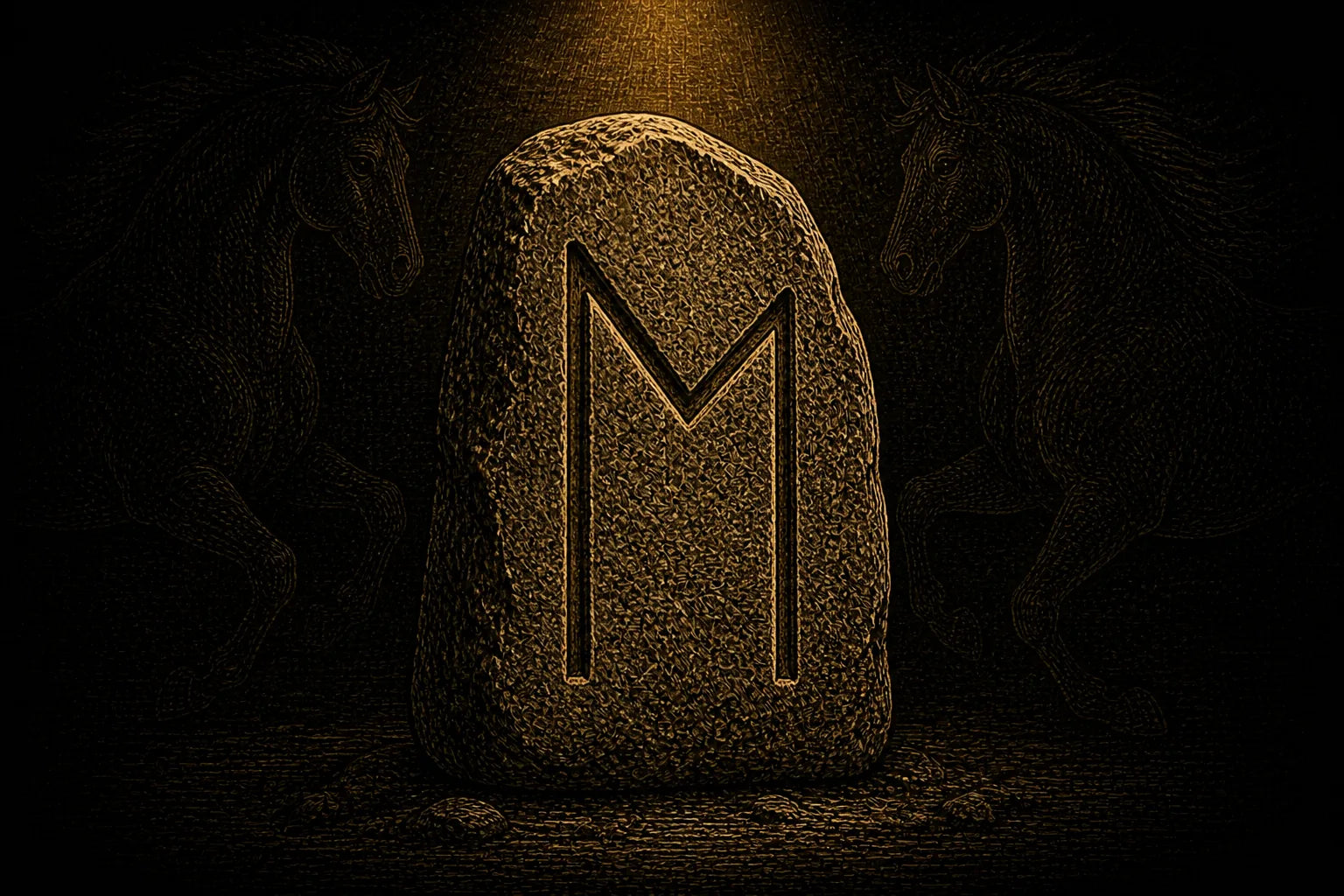
Mannaz is rune 20 of the 24-character Elder Futhark. Its reconstructed name opens toward “person or humanity,” while its early written voice carried the sound m. Together, name and sound form the root from which later ritual and divinatory meanings grow.
Mannaz at a glance
| Rune | ᛗ |
|---|---|
| Position | 20 of 24 · Third Ætt |
| Transliteration | m |
| Reconstructed name | *Mannaz |
| Literal gloss | person or humanity |
| Modern study themes | self-knowledge, community and human responsibility |
Runic roots and early use
Elder Futhark was an early Germanic writing system of 24 characters. Its surviving inscriptions are found on objects such as combs, weapons, jewellery, bracteates and stones. In an inscription, a rune first speaks as a sound within a word or name. In living practice, that same sign can also become a focus for meditation, divination, and magical intention.
The human/person gloss is supported by later Germanic rune-name evidence.
The asterisk in *Mannaz marks a scholarly reconstruction. The reconstructed names grow from comparison: later Anglo-Saxon and Scandinavian rune poems, Gothic rune-name evidence, historical linguistics, and the inscriptions themselves are read together. This creates a bridge between the early alphabet and the poetic language through which many practitioners meet the runes today.
What does Mannaz mean?
The shortest historically responsible answer is person or humanity. That name-gloss is the seed of the rune’s symbolic life. In different settings the sign may be a letter, part of a personal name, a complete word, an abbreviation, or part of an inscription made with ritual or magical intent.
Rune meaning in living practice
LIVING PRACTICE
Modern readers commonly use Mannaz to explore self-knowledge, community and human responsibility. Its challenging side can be framed as ego, conformity or forgetting the limits of individual knowledge. These reflective associations grow from the rune name, the later rune poems, modern reading systems, and the experiences practitioners continue to build around the sign.
Reflection question: How are you shaped by-and accountable to-other people?
Reading Mannaz upright or reversed
Some readers use reversals to reveal a blocked, inward, delayed, or challenging expression of a rune. Others read every rune as a complete field containing both gift and difficulty, allowing the question and surrounding signs to show which current is active. Symmetrical runes can also look unchanged when turned. Choose one method, record it in your rune journal, and let repeated practice teach you how it speaks.
How to work with Mannaz
- Speak and write the rune’s sound so its shape, name, and voice become connected.
- Read its name beside the Old English, Norwegian, and Icelandic rune poems where a corresponding stanza exists.
- Keep three pages in your journal: one for inscriptions, one for rune-poem imagery, and one for meanings discovered through practice.
- When you meet the rune in an inscription, read the whole word or object; when you draw it in divination, read its relationship with the question and neighboring signs.
- Use the rune as a conversation with possibility rather than a command that removes your judgment or another person’s choice.
Continue through the Elder Futhark
- Previous: ᛖ Ehwaz
- Next: ᛚ Laguz
- Explore all 24 Elder Futhark runes
- Read the complete Elder Futhark history guide
Sources and further reading
- Judith Jesch, Runes: A Concise History - The Earliest Period of Runic Writing, Oxford University Press
- National Museum of Denmark - Iron Age collections and runic objects
- Swedish History Museum - The Viking World and runic material
Reviewed 2026-08-13. This guide follows the rune from early writing and later rune poems into contemporary spiritual and divinatory practice.